 Kirchenakte
Person 1180 – 1233 · etwa 53 Jahre alt
· im Zeitstrahl zeigen
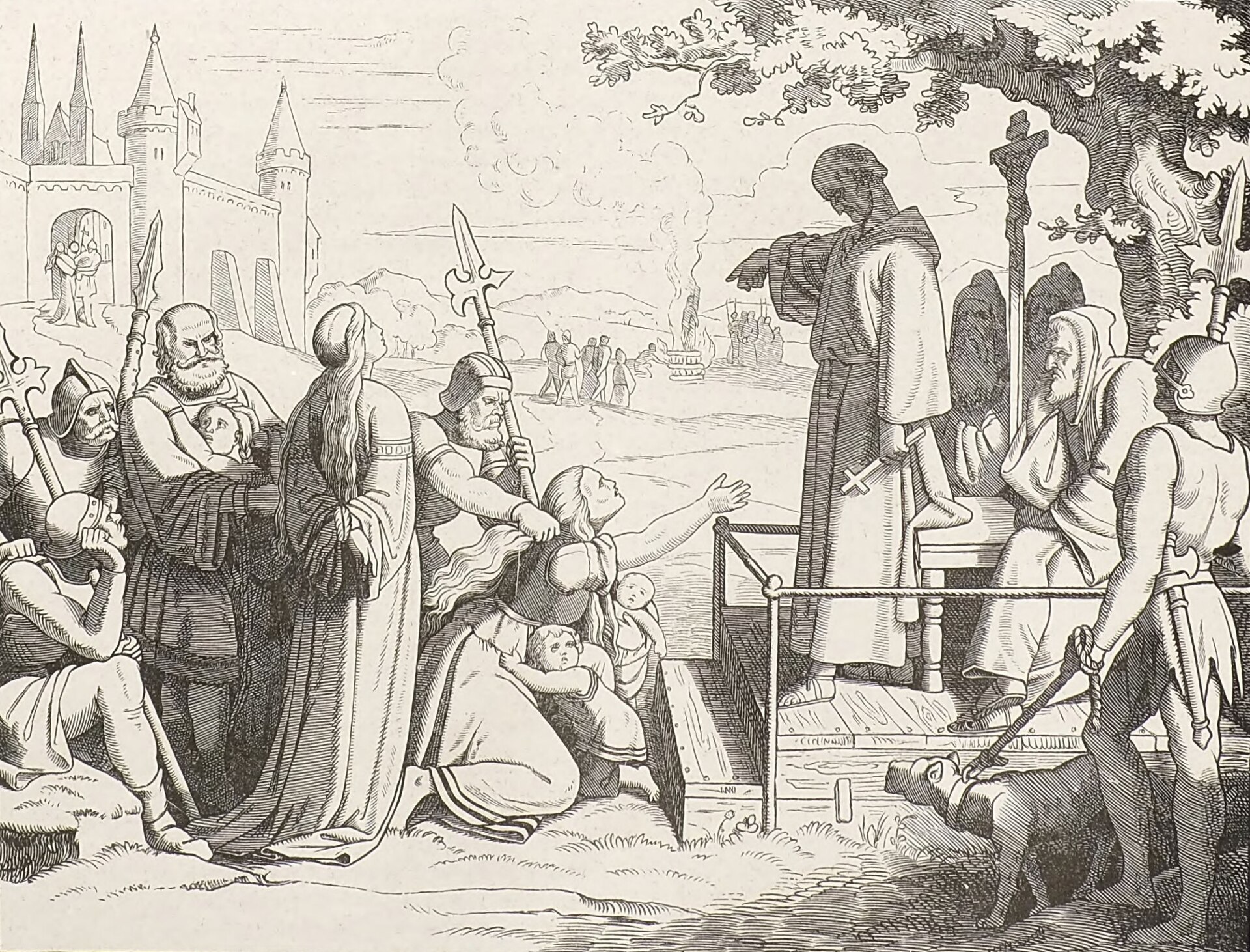
Konrad von Marburg, päpstlicher Ketzerverfolger in Deutschland
Der Priester Konrad von Marburg war ab 1227 im Auftrag von Papst Gregor IX. der erste Ketzerverfolger für ganz Deutschland. Der Papst gab ihm 1231 Vollmacht, ohne Anhörung und ohne Berufung zu urteilen. Wer angeklagt war, hatte nur die Wahl: gestehen und Mitschuldige nennen, oder verbrannt werden. So entstanden Ketten falscher Beschuldigungen, in denen Bruder den Bruder und die Frau den Mann anzeigte. Als Beichtvater ließ er Elisabeth von Thüringen und ihre Dienerinnen auspeitschen. 1233 wurde er ermordet; die Kirche begrub ihn neben Elisabeth.
- Lebensdaten
- 1180 – 1233 (etwa 53 Jahre alt)
- Land
- Deutschland
- Institutionen
- Heiliger Stuhl
Papst Gregor IX. - Kategorie
- Gewalt, Häresieverfahren, Verfolgung
- Belegstufe
- B zwei unabhängige Fachquellen · was heißt das?
.jpg)
Was den Menschen geschah
Wer war betroffen? Betroffene und Zahlen
- In Marburg ließ er viele Verdächtige festnehmen, darunter Ritter und Priester; wer nicht widerrief, wurde verbrannt. 1232 ließ er in Erfurt vier weitere Menschen verbrennen. Eine Landstreicherin, die sich an ihrer Familie rächen wollte, ließ er in ihren Heimatort schicken, wo sie die Verbrennung ihrer Verwandten bewirkte.
Beleg: Harper & Brothers; Project Gutenberg (eBook 39458), Bd. 2, Kap. Germany, S. 332
„In Marburg itself many suspects were seized, including knights, priests, and persons of condition, of whom some recanted and the rest were burned“
Henry Charles Lea, A History of the Inquisition of the Middle Ages, Bd. 2 (New York 1888), Bd. 2, Kap. Germany, S. 332. Original Beleg: Harper & Brothers; Project Gutenberg (eBook 39458), Bd. 2, Kap. Germany, S. 332
„On one excursion to Erfurt, moreover, in 1232, he took the opportunity to burn four more victims“
Henry Charles Lea, A History of the Inquisition of the Middle Ages, Bd. 2 (New York 1888), Bd. 2, Kap. Germany, S. 332. Original Beleg: Harper & Brothers; Project Gutenberg (eBook 39458), Bd. 2, Kap. Germany, S. 337
„sent her with his assistants to Clavelt, whence she came, where she caused the burning of her kindred“
Henry Charles Lea, A History of the Inquisition of the Middle Ages, Bd. 2 (New York 1888), Bd. 2, Kap. Germany, S. 337. Original
Wie wurden sie angeklagt und verurteilt?
- Am 12. Juni 1227 beauftragte Papst Gregor IX. ihn, Ketzer in Deutschland aufzuspüren und zu verfolgen, mit dem Recht, Gehilfen nach Belieben zu ernennen. Im Oktober 1231 erweiterte der Papst seine Vollmacht: Konrad musste die Fälle nicht einmal anhören, nur urteilen, endgültig und ohne Berufung.
Beleg: Harper & Brothers; Project Gutenberg (eBook 39458), Bd. 2, Kap. Germany, S. 329
„June 12, eight days before the commission issued to Giovanni di Salerno, Gregory wrote to Conrad commending highly the diligence with which he was tracking and pursuing heretics“
Henry Charles Lea, A History of the Inquisition of the Middle Ages, Bd. 2 (New York 1888), Bd. 2, Kap. Germany, S. 329. Original Beleg: Harper & Brothers; Project Gutenberg (eBook 39458), Bd. 2, Kap. Germany, S. 332
„he was not even required to hear the cases, but only to pronounce judgment, which was to be final and without appeal“
Henry Charles Lea, A History of the Inquisition of the Middle Ages, Bd. 2 (New York 1888), Bd. 2, Kap. Germany, S. 332. Original - Die Angeklagten hatten nur die Wahl, das Verlangte zu gestehen und Buße zu tun, oder für das Leugnen verbrannt zu werden. Wer gestand, wurde kahlgeschoren und musste alle nennen, die er bei den angeblichen nächtlichen Versammlungen gesehen hatte. Eine Verteidigung gab es nicht.
Beleg: Harper & Brothers; Project Gutenberg (eBook 39458), Bd. 2, Kap. Germany, S. 336
„the accused was allowed simply the option of confessing what was demanded of him, and receiving penance, or of being burned for denial“
Henry Charles Lea, A History of the Inquisition of the Middle Ages, Bd. 2 (New York 1888), Bd. 2, Kap. Germany, S. 336. Original Beleg: Harper & Brothers; Project Gutenberg (eBook 39458), Bd. 2, Kap. Germany, S. 336
„he devised the penance of shaving the head as a mark of humiliation for his converts, who were moreover, of course, obliged to give the names of all whom they had seen in the hideous nocturnal assemblies“
Henry Charles Lea, A History of the Inquisition of the Middle Ages, Bd. 2 (New York 1888), Bd. 2, Kap. Germany, S. 336. Original Beleg: Harper & Brothers; Project Gutenberg (eBook 39458), Bd. 2, Kap. Germany, S. 337
„As no one had the slightest opportunity of defence, some steadfast men preferred to be burned and thus earn salvation, rather than to confess to lies and falsely accuse others“
Henry Charles Lea, A History of the Inquisition of the Middle Ages, Bd. 2 (New York 1888), Bd. 2, Kap. Germany, S. 337. Original - Als Konrad den mächtigen Grafen von Sayn anklagte, prüfte eine Versammlung von Fürsten und Bischöfen in Mainz den Fall. Zeugen sagten aus, sie hätten den Grafen beschuldigen müssen, um ihr eigenes Leben zu retten; der Graf wurde freigesprochen.
Beleg: Harper & Brothers; Project Gutenberg (eBook 39458), Bd. 2, Kap. Germany, S. 340
„others felt emboldened to declare that they had been forced to accuse the count in order to save their own lives“
Henry Charles Lea, A History of the Inquisition of the Middle Ages, Bd. 2 (New York 1888), Bd. 2, Kap. Germany, S. 340. Original Beleg: Encyclopaedia Britannica, 11. Auflage (1911), Wikisource, Hauptteil
„An assembly at Mainz of bishops and princes declared Henry innocent, but Conrad demanded that this sentence should be reversed“
Conrad of Marburg, Hauptteil. Original
Was geschah mit den Betroffenen?
- Der Erzbischof von Mainz berichtete dem Papst: Bruder beschuldigte Bruder, die Frau den Mann, der Herr den Knecht. Ein Mann gestand später, Konrad zur Verurteilung mehrerer Unschuldiger gebracht zu haben. Die Erzbischöfe von Mainz, Trier und Köln mahnten Konrad zur Mäßigung; er lehnte ab.
Beleg: Harper & Brothers; Project Gutenberg (eBook 39458), Bd. 2, Kap. Germany, S. 337, Bericht an den Papst
„brother accused brother, the wife the husband, and the master the servant“
Henry Charles Lea, A History of the Inquisition of the Middle Ages, Bd. 2 (New York 1888), Bd. 2, Kap. Germany, S. 337, Bericht an den Papst. Original Beleg: Harper & Brothers; Project Gutenberg (eBook 39458), Bd. 2, Kap. Germany, S. 337
„a certain Amfrid, who finally confessed that he had led Conrad to condemn a number of innocent men“
Henry Charles Lea, A History of the Inquisition of the Middle Ages, Bd. 2 (New York 1888), Bd. 2, Kap. Germany, S. 337. Original Beleg: Harper & Brothers; Project Gutenberg (eBook 39458), Bd. 2, Kap. Germany, S. 337, Bericht an den Papst
„warned Master Conrad to proceed in so great a matter with more moderation and discretion, but he refused“
Henry Charles Lea, A History of the Inquisition of the Middle Ages, Bd. 2 (New York 1888), Bd. 2, Kap. Germany, S. 337, Bericht an den Papst. Original - Als Beichtvater der verwitweten Landgräfin Elisabeth von Thüringen, damals 18 Jahre alt, ließ er sie und ihre Dienerinnen bis aufs Hemd entkleiden und auspeitschen, schlug sie bei Ungehorsam und vertrieb ihre vertrauten Dienerinnen. Elisabeth starb mit 24 Jahren an den Folgen ihrer Askese.
Beleg: Harper & Brothers; Project Gutenberg (eBook 39458), Bd. 2, Kap. Germany, S. 327
„he caused them all to be stripped to their shifts and soundly scourged“
Henry Charles Lea, A History of the Inquisition of the Middle Ages, Bd. 2 (New York 1888), Bd. 2, Kap. Germany, S. 327. Original Beleg: Harper & Brothers; Project Gutenberg (eBook 39458), Bd. 2, Kap. Germany, S. 328
„When she disobeyed his orders he used to beat her and strike her“
Henry Charles Lea, A History of the Inquisition of the Middle Ages, Bd. 2 (New York 1888), Bd. 2, Kap. Germany, S. 328. Original Beleg: Harper & Brothers; Project Gutenberg (eBook 39458), Bd. 2, Kap. Germany, S. 326 f.
„a mother at fourteen, a widow at twenty, and dying of self-inflicted“
Henry Charles Lea, A History of the Inquisition of the Middle Ages, Bd. 2 (New York 1888), Bd. 2, Kap. Germany, S. 326 f.. Original
Hintergrund
Ablauf
- Konrad von Marburg wurde um 1180 geboren, wahrscheinlich in Marburg, und wurde Ende Juli 1233 bei Marburg ermordet: am 30. Juli laut Encyclopaedia Britannica, am 31. Juli laut Lea.
Beleg: Encyclopaedia Britannica, 11. Auflage (1911), Wikisource, Einleitung
„CONRAD OF MARBURG ( c. 1180–1233), German inquisitor, was born probably at Marburg“
Conrad of Marburg, Einleitung. Original Beleg: Encyclopaedia Britannica, 11. Auflage (1911), Wikisource, Schluss
„he was murdered near Marburg on the 30th of July 1233“
Conrad of Marburg, Schluss. Original Beleg: Harper & Brothers; Project Gutenberg (eBook 39458), Bd. 2, Kap. Germany, S. 341
„lay in wait for him near Marburg and despatched him, July 31, regardless of his entreaties for mercy“
Henry Charles Lea, A History of the Inquisition of the Middle Ages, Bd. 2 (New York 1888), Bd. 2, Kap. Germany, S. 341. Original
Warum? Begründung und Motive (laut Quellen)
- Konrad schickte dem Papst Schilderungen angeblicher Teufelsrituale mit Kröte, schwarzem Kater und Orgien, die er aus den Geständnissen gewonnen hatte. Gregor IX. glaubte sie und schrieb, selbst die Vernichtung ohne Rücksicht auf Geschlecht oder Alter sei keine ausreichende Strafe; Konrad sollte einen Kreuzzug gegen sie predigen.
Beleg: Harper & Brothers; Project Gutenberg (eBook 39458), Bd. 2, Kap. Germany, S. 334
„Its hideous rites were described in full detail by Master Conrad to Pope Gregory“
Henry Charles Lea, A History of the Inquisition of the Middle Ages, Bd. 2 (New York 1888), Bd. 2, Kap. Germany, S. 334. Original Beleg: Harper & Brothers; Project Gutenberg (eBook 39458), Bd. 2, Kap. Germany, S. 336, Brief Gregors IX.
„wiping them from the face of the earth without sparing sex or age“
Henry Charles Lea, A History of the Inquisition of the Middle Ages, Bd. 2 (New York 1888), Bd. 2, Kap. Germany, S. 336, Brief Gregors IX.. Original Beleg: Harper & Brothers; Project Gutenberg (eBook 39458), Bd. 2, Kap. Germany, S. 336
„Conrad was instructed forthwith to preach a crusade against them“
Henry Charles Lea, A History of the Inquisition of the Middle Ages, Bd. 2 (New York 1888), Bd. 2, Kap. Germany, S. 336. Original
Wer bekam das Vermögen, wer profitierte?
- Über das Vermögen Verurteilter entschied der Reichstag von Worms 1231: Eigengüter und bewegliche Habe an die Erben, Lehen an den Lehensherrn. Konrads Mitstreiter Konrad Tors richtete seine Angriffe gezielt gegen Wohlhabende und lockte den Adel mit der Aussicht auf Beschlagnahmungen, die geteilt würden.
Beleg: Harper & Brothers; Project Gutenberg (eBook 39458), Bd. 2, Kap. Germany, S. 331
„the Diet of Worms, on June 2 of the same year, had decided that the allodial lands and the movables should go to the heirs, the fiefs to the lord“
Henry Charles Lea, A History of the Inquisition of the Middle Ages, Bd. 2 (New York 1888), Bd. 2, Kap. Germany, S. 331. Original Beleg: Harper & Brothers; Project Gutenberg (eBook 39458), Bd. 2, Kap. Germany, S. 333
„directing his attacks against the more wealthy, and holding out the prospect of extensive confiscations to be divided“
Henry Charles Lea, A History of the Inquisition of the Middle Ages, Bd. 2 (New York 1888), Bd. 2, Kap. Germany, S. 333. Original
Reaktion der Kirche
- Konrad wurde in Marburg neben Elisabeth begraben; seine Gebeine kamen später mit ihren in die Elisabethkirche.
Beleg: Harper & Brothers; Project Gutenberg (eBook 39458), Bd. 2, Kap. Germany, S. 341
„The body was carried to Marburg and buried by the side of St. Elizabeth, and when the latter was translated to the magnificent Elizabethskirche, his bones were likewise carried thither“
Henry Charles Lea, A History of the Inquisition of the Middle Ages, Bd. 2 (New York 1888), Bd. 2, Kap. Germany, S. 341. Original
Siehe auch
-
1231 – 1834 · 603 Jahre
Die Inquisition: Entstehung, Verfahren, Strafen
- Deutschland
- Frankreich
- Italien
- Spanien
- Vatikanstadt
- Enteignung
- Folter
- Häresieverfahren
- Verfolgung
-
1430 – 1793 · 363 Jahre
Hexenverfolgung in Europa
- Deutschland
- Frankreich
- Polen
- Schweiz
- Spanien
- Vereinigtes Königreich
- Folter
- Mord
- Verfolgung
Fachliteratur und Nachschlagewerke
- Fachliteratur
Harper & Brothers; Project Gutenberg (eBook 39458): Henry Charles Lea, A History of the Inquisition of the Middle Ages, Bd. 2 (New York 1888). Original (abgerufen 11. 10. 2026) - Nachschlagewerk
Encyclopaedia Britannica, 11. Auflage (1911), Wikisource: Conrad of Marburg, 1. Januar 1911. Original (abgerufen 11. 10. 2026)
Änderungsprotokoll (1)
- : Aufgenommen
Zuletzt geändert am 12. Oktober 2026. Fehlt etwas oder stimmt etwas nicht? Ergänzung oder Korrektur vorschlagen.