Gian Pietro Carafa baute als Kardinal die Römische Inquisition auf und war laut der Catholic Encyclopedia „eine Generation lang der Schrecken der Andersgläubigen“. Als Papst Paul IV. (1555 bis 1559) sperrte er die Juden Roms in ein ummauertes Ghetto, das sie selbst bezahlen mussten, zwang sie, ihren Besitz außerhalb weit unter Wert zu verkaufen, und schrieb ihnen gelbe Hüte vor. In Ancona ließ er Juden, die sich nicht taufen lassen wollten, auf den Scheiterhaufen bringen: 24 Menschen starben. Seine Neffen bereicherte er mit Gütern, die er Gegnern weggenommen hatte. Nach seinem Tod stürzten die Römer sein Denkmal.
Tote
24(gezählt, In Ancona 1556 gehängte und verbrannte Juden portugiesischer Herkunft, 23 Männer und eine Frau)Beleg: Jewish Encyclopedia, Bd. 1 (1901)
„Twenty-three men and one woman, whose names have been handed down in chronicles, preferred death to apostasy, and these were all hanged together and afterward burnt on the Piazza della Mostra“
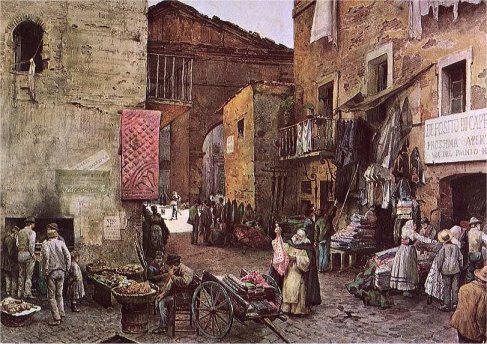
Das von Paul IV. errichtete Ghetto in Rom: Ettore Roesler Franz, Via Rua, um 1880
Bild: Ettore Roesler Franz,
Public domain,
Quelle
Was den Menschen geschah
Wer war betroffen? Betroffene und Zahlen
Am 26. Juli 1555 wurden alle Juden Roms in eine einzige Straße getrieben, die zwei Monate später ummauert wurde; die Mauer mussten sie selbst bezahlen. Alle Synagogen bis auf zwei wurden geschlossen. Juden mussten gelbe Hüte tragen, christliche Patienten durften keine jüdischen Ärzte mehr rufen.
Beleg: Jewish Encyclopedia, Bd. 10 (1905), Artikel Rome, Abschnitt Paul IV.
„On July 26, 1555, all the Jews were herded into one street; and two months later this street was enclosed by walls, for which the Jews were compelled to pay 100 scudi“
Rome, Artikel Rome, Abschnitt Paul IV..
OriginalBeleg: Jewish Encyclopedia, Bd. 10 (1905), Artikel Rome, Abschnitt Paul IV.
„All synagogues, except two, were condemned“
Rome, Artikel Rome, Abschnitt Paul IV..
OriginalBeleg: Jewish Encyclopedia, Bd. 10 (1905), Artikel Rome, Abschnitt Paul IV.
„ordered them to wear the yellow cap and hood, forbade trading in rags, and prohibited also the employment by Christians of Jewish physicians“
In Ancona ließ Paul IV. die Juden portugiesischer Herkunft, viele von ihnen vor der Spanischen Inquisition geflohen, durch einen Kommissar einsperren; wer sich nicht taufen ließ, sollte auf den Scheiterhaufen. 63 gaben aus Angst ihren Glauben auf. 23 Männer und eine Frau weigerten sich; sie wurden gemeinsam gehängt und danach verbrannt. Viele Juden flohen aus der Stadt.
Beleg: Jewish Encyclopedia, Bd. 1 (1901), Artikel Ancona, Persecution under Pope Paul IV.
„he sent an inhuman commissioner, a certain Cesare Galuaba, to Ancona with orders to incarcerate all who did not accept baptism and to condemn them to the stake“
Ancona, Artikel Ancona, Persecution under Pope Paul IV..
OriginalBeleg: Jewish Encyclopedia, Bd. 1 (1901), Artikel Ancona, Persecution under Pope Paul IV.
„Thus terrorized, sixty-three renounced their faith“
Ancona, Artikel Ancona, Persecution under Pope Paul IV..
OriginalBeleg: Jewish Encyclopedia, Bd. 1 (1901), Artikel Ancona, Persecution under Pope Paul IV.
„Thoroughly alarmed, many of the Jews fled“
Ancona, Artikel Ancona, Persecution under Pope Paul IV..
OriginalBeleg: Jewish Encyclopedia, Bd. 10 (1905), Artikel Rome, Abschnitt Paul IV.
„Paul IV. was exceedingly harsh in his treatment of the Maranos, whom he, on April 30, 1556, ordered to be burned at the stake in Ancona“
Schon als Kardinal ordnete er die Inquisition in Italien nach päpstlichem Muster neu und war eine Generation lang der Schrecken der Andersgläubigen. Als Papst machte er sie zum Machtinstrument; selbst Kardinal Morone ließ er wegen Häresieverdachts vor das Tribunal stellen und einsperren.
Beleg: The Catholic Encyclopedia, Bd. 11 (1911), Hauptteil
„He reorganized the Inquisition in Italy on papal lines and for a generation was the terror of misbelievers“
Pope Paul IV, Hauptteil.
OriginalBeleg: The Catholic Encyclopedia, Bd. 11 (1911), Hauptteil
„He made the Inquisition a powerful engine of government“
Pope Paul IV, Hauptteil.
OriginalBeleg: The Catholic Encyclopedia, Bd. 11 (1911), Hauptteil
„The great Cardinal Morone was brought before the tribunal on suspicion of heresy and committed to prison“
Bis heute wird in Synagogen jedes Jahr eine Totenklage für die Märtyrer von Ancona gesprochen.
Beleg: Jewish Encyclopedia, Bd. 1 (1901), Artikel Ancona, Persecution under Pope Paul IV.
„Prayers for the dead are still said, and the elegy composed by Jacob de Zano is still recited annually in the synagogues for these martyrs“
Ancona, Artikel Ancona, Persecution under Pope Paul IV..
Original
Nach seinem Tod stürzte die Menge sein Denkmal, griff den Palast an, misshandelte die Beamten und schlug die Tore des Ghettos ein.
Beleg: Jewish Encyclopedia, Bd. 10 (1905), Artikel Rome, Abschnitt Paul IV.
„As soon as Paul was dead his monument was torn down, the palace attacked, the officials maltreated, and the gates of the ghetto battered down“
Rome, Artikel Rome, Abschnitt Paul IV..
OriginalBeleg: The Catholic Encyclopedia, Bd. 11 (1911), Schluss
„lived to see it thrown down and mutilated by the hostile populace“
Gian Pietro Carafa wurde am 28. Juni 1476 bei Benevent geboren, am 23. Mai 1555 zum Papst gewählt und starb am 18. August 1559.
Beleg: The Catholic Encyclopedia, Bd. 11 (1911), Einleitung
„Born near Benevento, 28 June, 1476; elected 23 May, 1555; died 18 Aug., 1559“
Die Jewish Encyclopedia sieht in der Grausamkeit gegen die portugiesischen Juden auch seinen Hass auf die Spanier, der seine Politik prägte; die Catholic Encyclopedia nennt seine Abscheu vor der spanischen Herrschaft über seine Heimat Neapel.
Beleg: Jewish Encyclopedia, Bd. 1 (1901), Artikel Ancona, Persecution under Pope Paul IV.
„As a means of satisfying his feeling of hatred against the Spaniards, Paul IV. practised cruelty toward the Portuguese Jews“
Ancona, Artikel Ancona, Persecution under Pope Paul IV..
OriginalBeleg: The Catholic Encyclopedia, Bd. 11 (1911), Hauptteil
„that detestation of Spanish rule in his native land which characterized his public policy during his pontificate“
Die Juden mussten all ihren Besitz außerhalb der Ghettomauern verkaufen; trotz der niedrigen Preise brachte das 500.000 Kronen. Für die geschlossenen Synagogen mussten sie weiter Steuern zahlen. Ein Angebot von 40.000 Scudi, um die Anordnungen aufzuheben, lehnte der Papst ab.
Beleg: Jewish Encyclopedia, Bd. 10 (1905), Artikel Rome, Abschnitt Paul IV.
„the Jews were forced to sell all their property that was situated outside the walls. In spite of the low prices paid, this sale brought 500,000 crowns“
Rome, Artikel Rome, Abschnitt Paul IV..
OriginalBeleg: Jewish Encyclopedia, Bd. 10 (1905), Artikel Rome, Abschnitt Paul IV.
„the Jews were required to pay taxes for the synagogues that had been closed“
Rome, Artikel Rome, Abschnitt Paul IV..
OriginalBeleg: Jewish Encyclopedia, Bd. 10 (1905), Artikel Rome, Abschnitt Paul IV.
„the Jews' offer of 40,000 scudi for the revocation of this order was rejected“
Seinen Neffen Carlo Carafa, einen völlig ungeeigneten Mann ohne geistliche Ausbildung, machte er zum Kardinal; andere Verwandte bereicherte er mit Pfründen und Gütern, die er Anhängern der Spanier weggenommen hatte.
Beleg: The Catholic Encyclopedia, Bd. 11 (1911), Hauptteil
„Paul IV elevated to the cardinalate his nephew Carlo Caraffa, a man utterly unworthy and without any ecclesiastical training, and enriched other relatives with benefices and estates taken from those who favoured the Spaniards“
 Kirchenakte