 Kirchenakte
Jan Hus
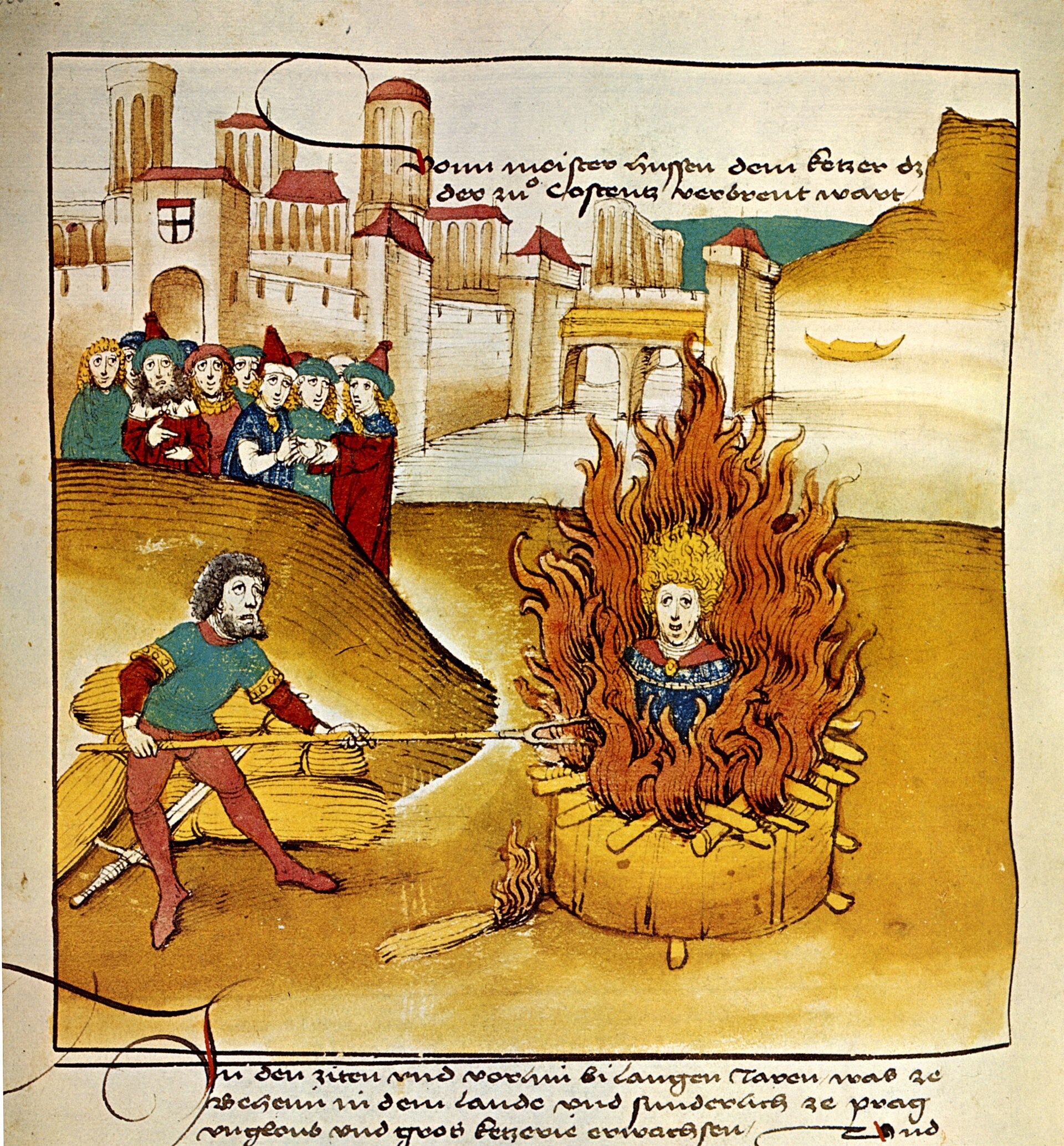
The Bohemian preacher Jan Hus was condemned at the Council of Constance and burned at the stake on 6 July 1415. In 1999 Pope John Paul II expressed his deep regret for the cruel death inflicted on Hus.
- Life dates
- 1369-1415 (about 46 years old)
- Acknowledgement by the Church
- 584 years later, on 17 December 1999: „I feel the need to express deep regret for the cruel death inflicted on John Hus“ (Address of the Holy Father to an International Symposium on John Hus, Original)
- Country
- Czechia
- Institutions
- Council of Constance
- Category
- Admission, Heresy trials
- Level of evidence
- A Primary source · what does this mean?
- Persons involved
- John Paul II (Pope)

What happened to the people
Who was affected? Victims and numbers
- In the dispute over indulgences, three young men were sentenced to death in June 1412 because, despite a ban on speaking, they had publicly asserted that the papal indulgence was unlawful. Hus himself died at the stake on 6 July 1415, his companion Jerome of Prague on 30 May 1416.
Evidence: Encyclopædia Britannica, 11. Auflage (1911), Artikel Huss, John
„three young men, for having openly asserted the unlawfulness of the papal indulgence after silence had been enjoined, were sentenced to death (June 1412)“
Huss, John, Artikel Huss, John. Original Evidence: The Catholic Encyclopedia, Bd. 7 (1910), Artikel Jan Hus
„The same fate befell Jerome of Prague 30 May, 1416.“
Jan Hus, Artikel Jan Hus. Original · Archive copy
How were they charged and sentenced?
- In Constance he was put on trial, condemned and burned at the stake on 6 July 1415.
Evidence: The Catholic Encyclopedia, Bd. 7 (1910), letzter Absatz
„At Constance he was tried, condemned, and burnt at the stake, 6 July, 1415“
Jan Hus, letzter Absatz. Original · Archive copy
What happened to those affected?
- At the hearing Hus was drowned out by violent heckling, and he was refused a defender. After the sentence he was degraded, and those present formally committed his soul to the devil; the council calmly continued with its agenda. After the burning his ashes and even the soil beneath were thrown into the Rhine.
Evidence: Encyclopædia Britannica, 11. Auflage (1911), Artikel Huss, John
„as soon as the accused began to enter upon his defence, he was assailed by violent outcries, amidst which it was impossible for him to be heard“
Huss, John, Artikel Huss, John. Original Evidence: Encyclopædia Britannica, 11. Auflage (1911), Artikel Huss, John
„afterwards even this concession to the forms of justice was denied“
Huss, John, Artikel Huss, John. Original Evidence: Encyclopædia Britannica, 11. Auflage (1911), Artikel Huss, John
„his soul was formally consigned by all those present to the devil“
Huss, John, Artikel Huss, John. Original Evidence: Encyclopædia Britannica, 11. Auflage (1911), Artikel Huss, John
„the council meanwhile proceeding unconcernedly with the rest of its business for the day“
Huss, John, Artikel Huss, John. Original Evidence: Encyclopædia Britannica, 11. Auflage (1911), Artikel Huss, John
„the ashes that were left and even the soil on which they lay were carefully removed and thrown into the Rhine“
Huss, John, Artikel Huss, John. Original
Witness accounts and records
I write this,” says he, in a letter to his friends at Prague , “in prison and in chains, expecting to-morrow to receive sentence of death, full of hope in God that I shall not swerve from the truth, nor abjure errors imputed to me by false witnesses.
God is my witness that I have never taught or preached that which false witnesses have testified against me. He knows that the great object of all my preaching and writing was to convert men from sin. In the truth of that gospel which hitherto I have written, taught and preached, I now joyfully die.
Background
Course of events
- Hus was born in 1369 in Husinec in southern Bohemia and died on 6 July 1415 in Constance.
Evidence: The Catholic Encyclopedia, Bd. 7 (1910), Einleitung
„Born at Husinetz in southern Bohemia, 1369; died at Constance 6 July, 1415“
Jan Hus, Einleitung. Original · Archive copy
Why? Justification and motives (according to the sources)
- Hus came to Constance trusting in an imperial safe-conduct. According to the Britannica, the safe-conduct was probably issued to lure him to Constance; King Sigismund himself admitted the breach of his word. The council demanded unconditional recantation. Hus refused because that would have been a dishonest admission of guilt, and insisted, among other things, that Christ, not Peter, was the head of the Church.
Evidence: Encyclopædia Britannica, 11. Auflage (1911), Artikel Huss, John
„The treachery of King Sigismund is undeniable, and was indeed admitted by the king himself. The safe conduct was probably indeed given by him to entice Huss to Constance.“
Huss, John, Artikel Huss, John. Original Evidence: Encyclopædia Britannica, 11. Auflage (1911), Artikel Huss, John
„when asked to make a general recantation he steadfastly declined, on the ground that to do so would be a dishonest admission of previous guilt“
Huss, John, Artikel Huss, John. Original Evidence: Encyclopædia Britannica, 11. Auflage (1911), Artikel Huss, John
„to the effect that Christ, not Peter, is the head of the church to whom ultimate appeal must be made“
Huss, John, Artikel Huss, John. Original
Who received the assets, who profited?
- In 1411 Pope John XXIII proclaimed indulgences for all who gave money for the crusade against King Ladislaus of Naples. Hus sharply attacked these bulls and taught that indulgences could never be sold without simony. Thereupon the ban against him was renewed and every place that received him was placed under interdict; the pope ordered his arrest.
Evidence: The Catholic Encyclopedia, Bd. 7 (1910), Artikel Jan Hus
„With no less vehemence Hus attacked the Bulls (9 September and 2 December 1411) in which John XXIII proclaimed indulgences to all who would supply funds for the crusade against Ladislaus of Naples.“
Jan Hus, Artikel Jan Hus. Original · Archive copy Evidence: Encyclopædia Britannica, 11. Auflage (1911), Artikel Huss, John
„his doctrine that indulgence could never be sold without simony“
Huss, John, Artikel Huss, John. Original Evidence: Encyclopædia Britannica, 11. Auflage (1911), Artikel Huss, John
„the excommunication against Huss was renewed, and the interdict again laid on all places which should give him shelter“
Huss, John, Artikel Huss, John. Original Evidence: The Catholic Encyclopedia, Bd. 7 (1910), Artikel Jan Hus
„Finally the pope ordered Hus to be imprisoned and the Bethlehem chapel destroyed.“
Jan Hus, Artikel Jan Hus. Original · Archive copy
Response of the Church
- On 17 December 1999 Pope John Paul II expressed deep regret for the cruel death of Hus.
Evidence: Heiliger Stuhl, Überschrift
„ADDRESS OF THE HOLY FATHER TO AN INTERNATIONAL SYMPOSIUM ON JOHN HUS 17 December 1999“
Address of the Holy Father to an International Symposium on John Hus, Überschrift. Original · Archive copy Evidence: Heiliger Stuhl, Nr. 1
„I feel the need to express deep regret for the cruel death inflicted on John Hus“
Address of the Holy Father to an International Symposium on John Hus, Nr. 1. Original · Archive copy
Original documents to read
- Church document
Heiliger Stuhl: Address of the Holy Father to an International Symposium on John Hus, 17 December 1999. Original · Archive copy (retrieved 11 Oct 2026)
Scholarly literature and reference works
- Reference work
The Catholic Encyclopedia, Bd. 7 (1910): Jan Hus, 1 January 1910. Original · Archive copy (retrieved 11 Oct 2026) - Reference work
Encyclopædia Britannica, 11. Auflage (1911): Huss, John, 1 January 1911. Original (retrieved 15 Oct 2026)
Change log (6)
The change log is kept in German only.
- : Aktualisiert: Englische Übersetzung
- : Aktualisiert: Zeitzeugen und Originaltexte, Tatsachen, Quellen
- : Aktualisiert: Tatsachen
- : Aktualisiert: Tatsachen
- : Aktualisiert: Tatsachen
- : Aktualisiert: Anerkennung durch die Kirche
Last changed on 22 October 2026. Is something missing or wrong? Suggest an addition or correction.