 Kirchenakte
Person 1412-1431 · about 19 years old
· show in timeline
Joan of Arc
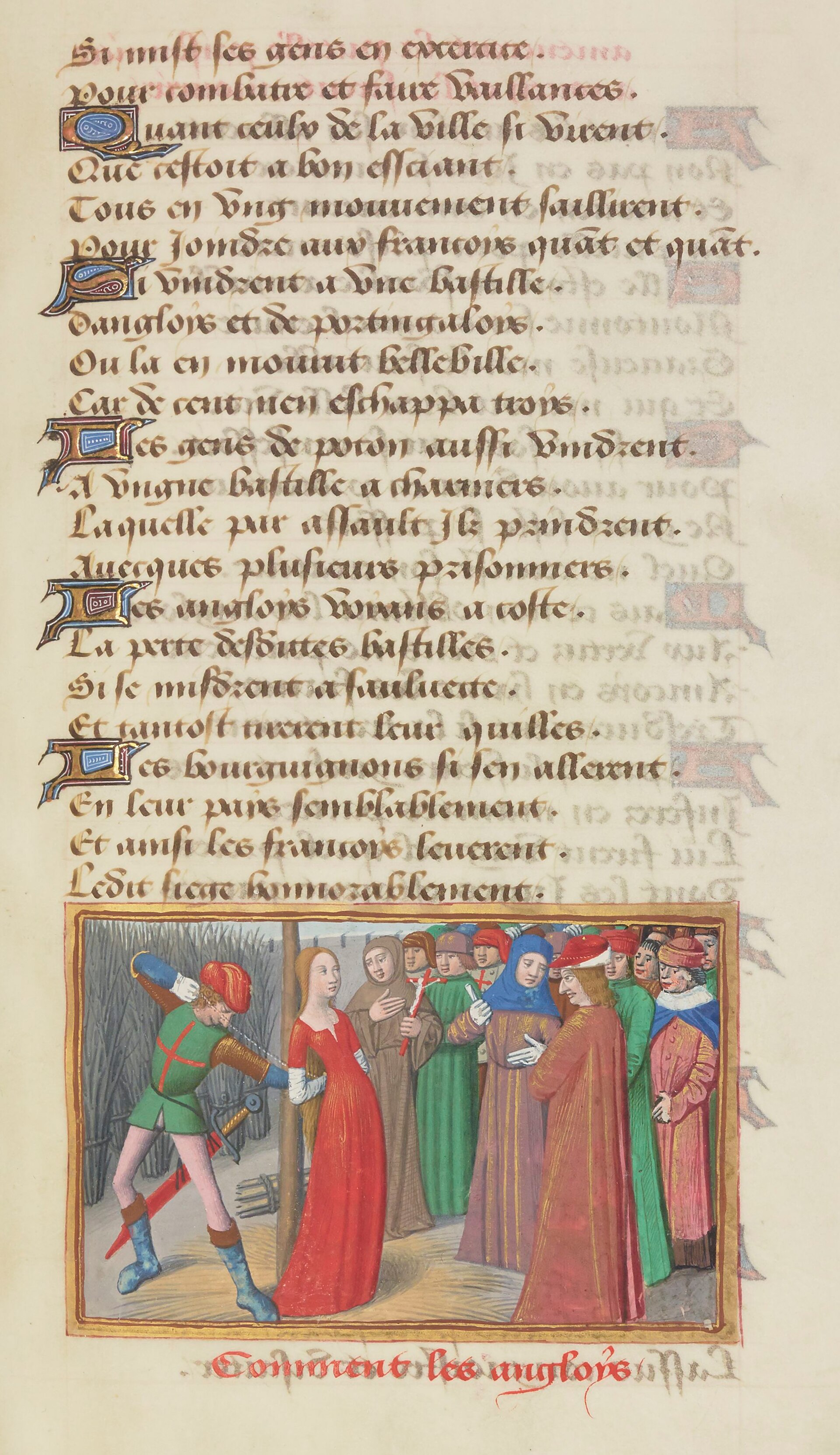
In 1431 Joan of Arc was condemned as a heretic by a church court in Rouen and burned at the stake on 30 May 1431. A nullity trial under Pope Callixtus III declared the conviction null and void on 7 July 1456.
- Life dates
- 1412-1431 (about 19 years old)
- Acknowledgement by the Church
- 25 years later, on 7 July 1456: „ended with a solemn sentence that declared the condemnation null and void (7 July 1456“ (Benedict XVI, General Audience: Saint Joan of Arc, Original)
- Country
- France
- Institutions
- Church court in Rouen
- Category
- Heresy trials, Rehabilitation
- Level of evidence
- A Primary source · what does this mean?
- Persons involved
- Pierre Cauchon (Bishop, judge)
Jean le Maistre (Inquisitor, judge)
Callixtus III (Pope, under whom the nullity trial took place)

What happened to the people
Who was affected? Victims and numbers
- Joan of Arc was burned at the stake in Rouen on 30 May 1431, and her ashes were thrown into the Seine.
Evidence: Encyclopædia Britannica, 11. Auflage (1911), Artikel Joan of Arc
„burned at the stake on the streets of Rouen on the 30th of May 1431“
Joan of Arc, Artikel Joan of Arc. Original Evidence: The Catholic Encyclopedia, Bd. 8 (1910), Herbert Thurston, Artikel St. Joan of Arc
„After death her ashes were thrown into the Seine.“
St. Joan of Arc, Artikel St. Joan of Arc. Original
How were they charged and sentenced?
- The trial of condemnation in Rouen began in February 1431 and ended on 30 May 1431 with her burning.
Evidence: Heiliger Stuhl, Abschnitt zum Prozess
„the long and dramatic Trial of Condemnation took place, that began in February 1431 and ended on 30 May with her being burned at the stake“
Benedict XVI, General Audience: Saint Joan of Arc, Abschnitt zum Prozess. Original · Archive copy - Two church judges presided: Bishop Pierre Cauchon and the inquisitor Jean le Maistre.
Evidence: Heiliger Stuhl, Abschnitt zum Prozess
„two ecclesiastical judges presided, Bishop Pierre Cauchon and the Inquisitor Jean le Maistre“
Benedict XVI, General Audience: Saint Joan of Arc, Abschnitt zum Prozess. Original · Archive copy - The ecclesiastical judges condemned her as a heretic to death at the stake.
Evidence: Heiliger Stuhl, Abschnitt zum Prozess
„Joan was accused and convicted by them, even condemned as a heretic and sent to the terrible death of being burned at the stake“
Benedict XVI, General Audience: Saint Joan of Arc, Abschnitt zum Prozess. Original · Archive copy
What happened to those affected?
- Although she stood before a church court, she was unlawfully held in a secular prison, the castle of Rouen, guarded by English soldiers; at first she was kept in an iron cage, chained by the neck, hands and feet. She was given no defender and was not allowed to attend Mass. When she wore men's clothing again, she was sentenced to death as a relapsed heretic. The sources contradict each other on the start of the trial: the Britannica names a public examination from 9 January 1431, the Catholic Encyclopedia 21 February 1431 as her first appearance before the judges.
Evidence: The Catholic Encyclopedia, Bd. 8 (1910), Herbert Thurston, Artikel St. Joan of Arc
„She was not allowed an advocate, and, though accused in an ecclesiastical court , she was throughout illegally confined in the Castle of Rouen, a secular prison , where she was guarded by dissolute English soldiers.“
St. Joan of Arc, Artikel St. Joan of Arc. Original Evidence: The Catholic Encyclopedia, Bd. 8 (1910), Herbert Thurston, Artikel St. Joan of Arc
„where she was at first kept in an iron cage, chained by the neck, hands, and feet“
St. Joan of Arc, Artikel St. Joan of Arc. Original Evidence: Encyclopædia Britannica, 11. Auflage (1911), Artikel Joan of Arc
„having been induced by those who had her in charge to resume her male clothes, she was on this account judged to have relapsed“
Joan of Arc, Artikel Joan of Arc. Original Evidence: Encyclopædia Britannica, 11. Auflage (1911), Artikel Joan of Arc
„After a public examination, begun on the 9th of January and lasting six days“
Joan of Arc, Artikel Joan of Arc. Original Evidence: The Catholic Encyclopedia, Bd. 8 (1910), Herbert Thurston, Artikel St. Joan of Arc
„it was only on 21 February, 1431, that Joan appeared for the first time before her judges“
St. Joan of Arc, Artikel St. Joan of Arc. Original
Witness accounts and records
"Until the last," said Manchon, the recorder at the trial, "she declared that her voices came from God and had not deceived her."
Background
Course of events
- Joan of Arc was born in 1412.
Evidence: Heiliger Stuhl, 6. Absatz
„when Joan was born, in 1412“
Benedict XVI, General Audience: Saint Joan of Arc, 6. Absatz. Original · Archive copy
Why? Justification and motives (according to the sources)
- According to the Catholic Encyclopedia, the English wanted to kill her at any price; since they could not execute her for having beaten them, they had her condemned as a witch and heretic. Their tool was Bishop Pierre Cauchon of Beauvais, an "unscrupulous and ambitious" partisan of Burgundy who, according to the Britannica, hoped for the archbishopric of Rouen. The University of Paris and the Inquisition pursued her handover with great perseverance.
Evidence: The Catholic Encyclopedia, Bd. 8 (1910), Herbert Thurston, Artikel St. Joan of Arc
„They could not put her to death for having beaten them, but they could get her sentenced as a witch and a heretic . Moreover, they had a tool ready to their hand in Pierre Cauchon, the Bishop of Beauvais , an unscrupulous and ambitious man who was the creature of the Burgundian party.“
St. Joan of Arc, Artikel St. Joan of Arc. Original Evidence: Encyclopædia Britannica, 11. Auflage (1911), Artikel Joan of Arc
„By means of negotiations instigated and prosecuted with great perseverance by the university of Paris and the Inquisition, and through the persistent scheming of Pierre Cauchon, the bishop of Beauvais—a Burgundian partisan, who, chased from his own see, hoped to obtain the archbishopric of Rouen“
Joan of Arc, Artikel Joan of Arc. Original
Who received the assets, who profited?
- John of Luxembourg sold the prisoner to the English, according to the Catholic Encyclopedia (1910) for a sum equivalent to several hundred thousand dollars in present-day money. King Charles VII made no effort to ransom or exchange her.
Evidence: The Catholic Encyclopedia, Bd. 8 (1910), Herbert Thurston, Artikel St. Joan of Arc
„Joan was sold by John of Luxembourg to the English for a sum which would amount to several hundred thousand dollars in modern money.“
St. Joan of Arc, Artikel St. Joan of Arc. Original Evidence: Encyclopædia Britannica, 11. Auflage (1911), Artikel Joan of Arc
„made no effort to effect her ransom, and never showed any sign of interest in her fate“
Joan of Arc, Artikel Joan of Arc. Original
Response of the Church
- The nullity trial under Pope Callixtus III declared the conviction null and void on 7 July 1456.
Evidence: Heiliger Stuhl, Abschnitt zum Prozess
„About 25 years later the Trial of Nullity, which opened under the authority of Pope Calixtus III, ended with a solemn sentence that declared the condemnation null and void (7 July 1456“
Benedict XVI, General Audience: Saint Joan of Arc, Abschnitt zum Prozess. Original · Archive copy
Original documents to read
- Church document
Heiliger Stuhl: Benedict XVI, General Audience: Saint Joan of Arc, 26 January 2011. Original · Archive copy (retrieved 11 Oct 2026)
Scholarly literature and reference works
- Reference work
The Catholic Encyclopedia, Bd. 8 (1910), Herbert Thurston: St. Joan of Arc, 1 January 1910. Original (retrieved 15 Oct 2026) - Reference work
Encyclopædia Britannica, 11. Auflage (1911): Joan of Arc, 1 January 1911. Original (retrieved 15 Oct 2026)
Change log (7)
The change log is kept in German only.
- : Aktualisiert: Englische Übersetzung
- : Aktualisiert: Zeitzeugen und Originaltexte, Tatsachen, Quellen
- : Aktualisiert: Personen
- : Aktualisiert: Tatsachen
- : Aktualisiert: Tatsachen
- : Aktualisiert: Tatsachen
- : Aktualisiert: Anerkennung durch die Kirche
Last changed on 22 October 2026. Is something missing or wrong? Suggest an addition or correction.