 Kirchenakte
St Bartholomew's Day Massacre 1572 and the reaction in Rome
On 24 August 1572, St Bartholomew's Day, the murder of the Huguenots, the French Protestants, began in Paris; in the following weeks the massacres spread to the provinces, in Toulouse until 23 September, in Bordeaux until 3 October. In one Paris cemetery alone 1,100 dead were buried, and many bodies were thrown into the Seine; estimates for the whole of France range up to 50,000 and more. According to the Britannica, the killing was set off by the Queen Mother Catherine de' Medici. On hearing the news, Pope Gregory XIII had bonfires lit and a commemorative medal struck.
Evidence: The Catholic Encyclopedia, Bd. 13 (1912)
„Thirty-five livres were paid to the grave-diggers of the Cemetery of the Innocents for the interment of 1100 corpses; but many were thrown into the Seine“
Evidence: The Catholic Encyclopedia, Bd. 13 (1912)
„Ranke and Henri Martin estimate the number of victims in Paris at 2000“
Evidence: Encyclopædia Britannica, 11. Auflage (1911)
„François Hotman estimates the number killed in the whole of France at 50,000“
- Period
- 24 Aug 1572-3 Oct 1572 (41 days)
- Country
- France, Vatican City
- Institutions
- French Crown
Holy See - Category
- Murder, Persecution
- Level of evidence
- B two independent scholarly sources · what does this mean?
- Persons
- Gregory XIII (Pope)
Catherine de' Medici (Queen Mother of France)
Admiral Coligny (leader of the Huguenots, murdered)
Téligny (son-in-law of Coligny, murdered)
Petrus Ramus (philosopher, murdered)
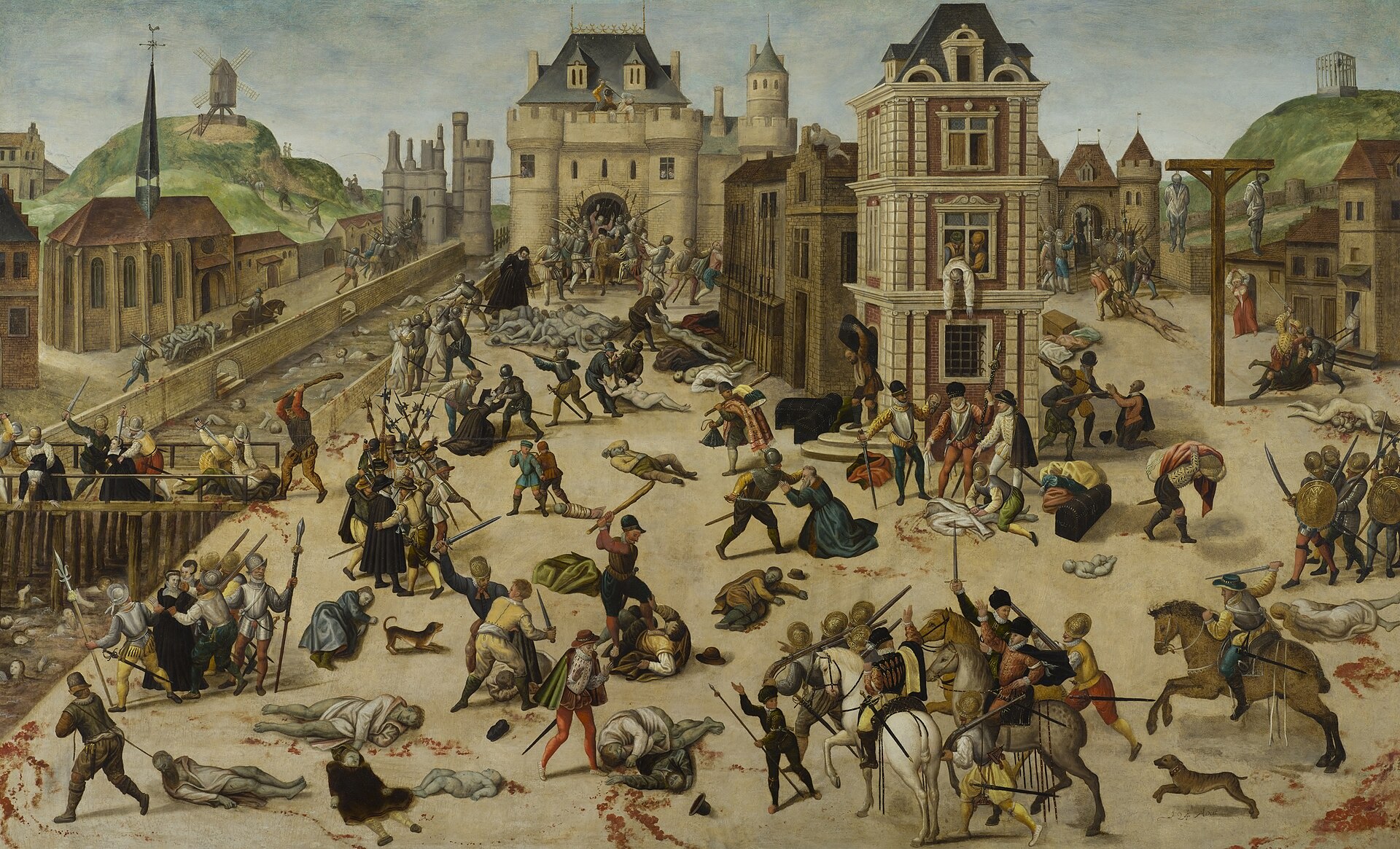

What happened to the people
Who was affected? Victims and numbers
- The victims of the massacre were the Protestants of France, the Huguenots. It began in Paris on 24 August 1572, the feast of St Bartholomew, and continued in the provinces in the following weeks.
Evidence: The Catholic Encyclopedia, Bd. 13 (1912), Einleitung
„This massacre of which Protestants were the victims occurred in Paris on 24 August, 1572 (the feast of St. Bartholomew ), and in the provinces of France during the ensuing weeks“
Saint Bartholomew's Day Massacre, Einleitung. Original - The number of dead in the provinces is unknown; the figures vary between 2,000 and 100,000. Among the victims were Admiral Coligny, his son-in-law Téligny and the philosopher Petrus Ramus, who was murdered on 25 August despite an express prohibition by the king.
Evidence: The Catholic Encyclopedia, Bd. 13 (1912), Abschnitt zu den Opfern
„The number of victims in the provinces is unknown, the figures varying between 2000 and 100,000“
Saint Bartholomew's Day Massacre, Abschnitt zu den Opfern. Original Evidence: Encyclopædia Britannica, 11. Auflage (1911), Schluss
„There were many illustrious victims, among them being Admiral Coligny, his son-in-law Charles de Téligny and the logician Peter Ramus“
St Bartholomew, Massacre of, Schluss. Original Evidence: The Catholic Encyclopedia, Bd. 13 (1912), Abschnitt zum Verlauf
„on 25 August Ramus, the celebrated philosopher, was assassinated in spite of the formal prohibition of the king and queen“
Saint Bartholomew's Day Massacre, Abschnitt zum Verlauf. Original
What happened to those affected?
- The dead were buried in mass graves or thrown into the Seine. By order under the royal seal, the Huguenots in Orléans were to be dealt with as in Paris; the killing dragged on until October.
Evidence: The Catholic Encyclopedia, Bd. 13 (1912), Abschnitt zu den Opfern
„a messenger brought to the Provost of Orléans a letter bearing the royal seal and ordering him to treat all Huguenots like those“
Saint Bartholomew's Day Massacre, Abschnitt zu den Opfern. Original Evidence: The Catholic Encyclopedia, Bd. 13 (1912), Abschnitt zu den Opfern
„the Toulouse massacre did not occur till 23 September and that of Bordeaux till 3 October“
Saint Bartholomew's Day Massacre, Abschnitt zu den Opfern. Original
Witness accounts and records
"If the Admiral had died from the shot," wrote Salviati, the nuncio , "no others would have been killed."
"Good God ! since you deem it well to kill the Admiral, I agree, but all the Huguenots in France must likewise perish, so that not one be left later to upbraid me."
Background
Course of events
- According to the Britannica, the impetus came from the Queen Mother Catherine de' Medici. She first wanted to have Admiral Coligny, the leader of the Huguenots, murdered; the attempt on 22 August failed, and he was killed in the night of 24 August. Some provincial governors refused to carry out the massacres.
Evidence: Encyclopædia Britannica, 11. Auflage (1911), Einleitung
„The initiative for the crime rests with Catherine de’ Medici“
St Bartholomew, Massacre of, Einleitung. Original Evidence: The Catholic Encyclopedia, Bd. 13 (1912), Abschnitt zur Vorgeschichte
„distinguish carefully between the attempted murder of Coligny on 22 August and his assassination on the night of 23-24 August, and the general massacre of Protestants“
Saint Bartholomew's Day Massacre, Abschnitt zur Vorgeschichte. Original Evidence: Encyclopædia Britannica, 11. Auflage (1911), Schluss
„and other provincial governors, refused to authorize the massacres“
St Bartholomew, Massacre of, Schluss. Original
Why? Justification and motives (according to the sources)
- The sources assess the planning differently. The Britannica writes that after the failed attempt on Coligny, Catherine de' Medici decided to kill all the Huguenot leaders at one stroke and to destroy the Protestant party, and persuaded the king that this was a measure of public safety. The Catholic Encyclopedia considers only the attempt on Coligny to have been planned and the massacre a cruel impulse; Catherine wanted thereby to secure her influence over the king and to prevent the revenge of the Huguenots. Philip II of Spain had the cardinal secretary of state of Gregory XIII told through the nuncio in Spain that now was the time to purge the kingdom of its enemies.
Evidence: Encyclopædia Britannica, 11. Auflage (1911), Artikel St Bartholomew, Massacre of
„Catherine then conceived the idea of killing at a blow all the Huguenot leaders, and of definitely ruining the Protestant party.“
St Bartholomew, Massacre of, Artikel St Bartholomew, Massacre of. Original Evidence: Encyclopædia Britannica, 11. Auflage (1911), Artikel St Bartholomew, Massacre of
„she persuaded the king that the massacre was a measure of public safety“
St Bartholomew, Massacre of, Artikel St Bartholomew, Massacre of. Original Evidence: The Catholic Encyclopedia, Bd. 13 (1912), Artikel Saint Bartholomew's Day Massacre
„the attempt on Coligny's life was premeditated whereas the massacre was the outcome of a cruel impulse“
Saint Bartholomew's Day Massacre, Artikel Saint Bartholomew's Day Massacre. Original Evidence: The Catholic Encyclopedia, Bd. 13 (1912), Artikel Saint Bartholomew's Day Massacre
„she saw in this decision a means of preserving her influence over the king and of preventing the vengeance of Protestants“
Saint Bartholomew's Day Massacre, Artikel Saint Bartholomew's Day Massacre. Original Evidence: The Catholic Encyclopedia, Bd. 13 (1912), Artikel Saint Bartholomew's Day Massacre
„The King (Philip II) bids me say that if his Most Christian Majesty means to purge his kingdom of its enemies, the time is now opportune“
Saint Bartholomew's Day Massacre, Artikel Saint Bartholomew's Day Massacre. Original
Who received the assets, who profited?
- Besides the royal troops, at Catherine's instigation Marcel, the former provost of the Paris merchants, raised the masses of the people, who were to attack and plunder the Huguenots.
Evidence: The Catholic Encyclopedia, Bd. 13 (1912), Artikel Saint Bartholomew's Day Massacre
„Marcel drew up the masses, over whom he had unlimited influence, and who, together with the royal troops, were to attack and plunder the Huguenots“
Saint Bartholomew's Day Massacre, Artikel Saint Bartholomew's Day Massacre. Original
Response of the Church
- Catherine de' Medici received the congratulations of all the Catholic powers. Pope Gregory XIII ordered bonfires to be lit and a commemorative medal to be struck.
Evidence: Encyclopædia Britannica, 11. Auflage (1911), Schluss
„Catherine de’ Medici received the congratulations of all the Catholic powers, and Pope Gregory XIII. commanded bonfires to be lighted and a medal to be struck“
St Bartholomew, Massacre of, Schluss. Original - Gregory XIII went with all the cardinals to the Te Deum in the Church of San Marco and prayed that the king might purge his entire kingdom of the "Huguenot plague". At a procession of thanksgiving on 8 September he thanked God for "a glorious triumph" of the Catholic people "over a perfidious race". He ordered a jubilee, had Vasari paint the victory over the Huguenots next to the victory of Lepanto in the Vatican and had a medal struck showing an exterminating angel striking down the Huguenots with a sword, with the inscription "Hugonottorum strages".
Evidence: The Catholic Encyclopedia, Bd. 13 (1912), Artikel Saint Bartholomew's Day Massacre
„Then with all the cardinals he repaired to the Church of St. Mark for the Te Deum , and prayed and ordered prayers that the Most Christian King might rid and purge his entire kingdom of the Huguenot plague.“
Saint Bartholomew's Day Massacre, Artikel Saint Bartholomew's Day Massacre. Original Evidence: The Catholic Encyclopedia, Bd. 13 (1912), Artikel Saint Bartholomew's Day Massacre
„thanked God for having "granted the Catholic people a glorious triumph over a perfidious race"“
Saint Bartholomew's Day Massacre, Artikel Saint Bartholomew's Day Massacre. Original Evidence: The Catholic Encyclopedia, Bd. 13 (1912), Artikel Saint Bartholomew's Day Massacre
„Gregory XIII ordered a jubilee in celebration of both events and engaged Vasari to paint side by side in one of the Vatican apartments scenes commemorative of the victory of Lepanto and of the triumph of the Most Christian King over the Huguenots . Finally, he had a medal struck representing an exterminating angel smiting the Huguenots with his sword, the inscription reading: Hugonottorum strages .“
Saint Bartholomew's Day Massacre, Artikel Saint Bartholomew's Day Massacre. Original
Scholarly literature and reference works
- Reference work
The Catholic Encyclopedia, Bd. 13 (1912): Saint Bartholomew's Day Massacre, 1 January 1912. Original (retrieved 11 Oct 2026) - Reference work
Encyclopædia Britannica, 11. Auflage (1911): St Bartholomew, Massacre of, 1 January 1911. Original (retrieved 11 Oct 2026)
Change log (7)
The change log is kept in German only.
- : Aktualisiert: Englische Übersetzung
- : Aktualisiert: Zeitzeugen und Originaltexte, Tatsachen
- : Aktualisiert: Personen
- : Aktualisiert: Titel
- : Aktualisiert: Tatsachen
- : Aktualisiert: Tatsachen
- : Aufgenommen
Last changed on 22 October 2026. Is something missing or wrong? Suggest an addition or correction.