 Kirchenakte
1838 · less than 1 year
· show in timeline
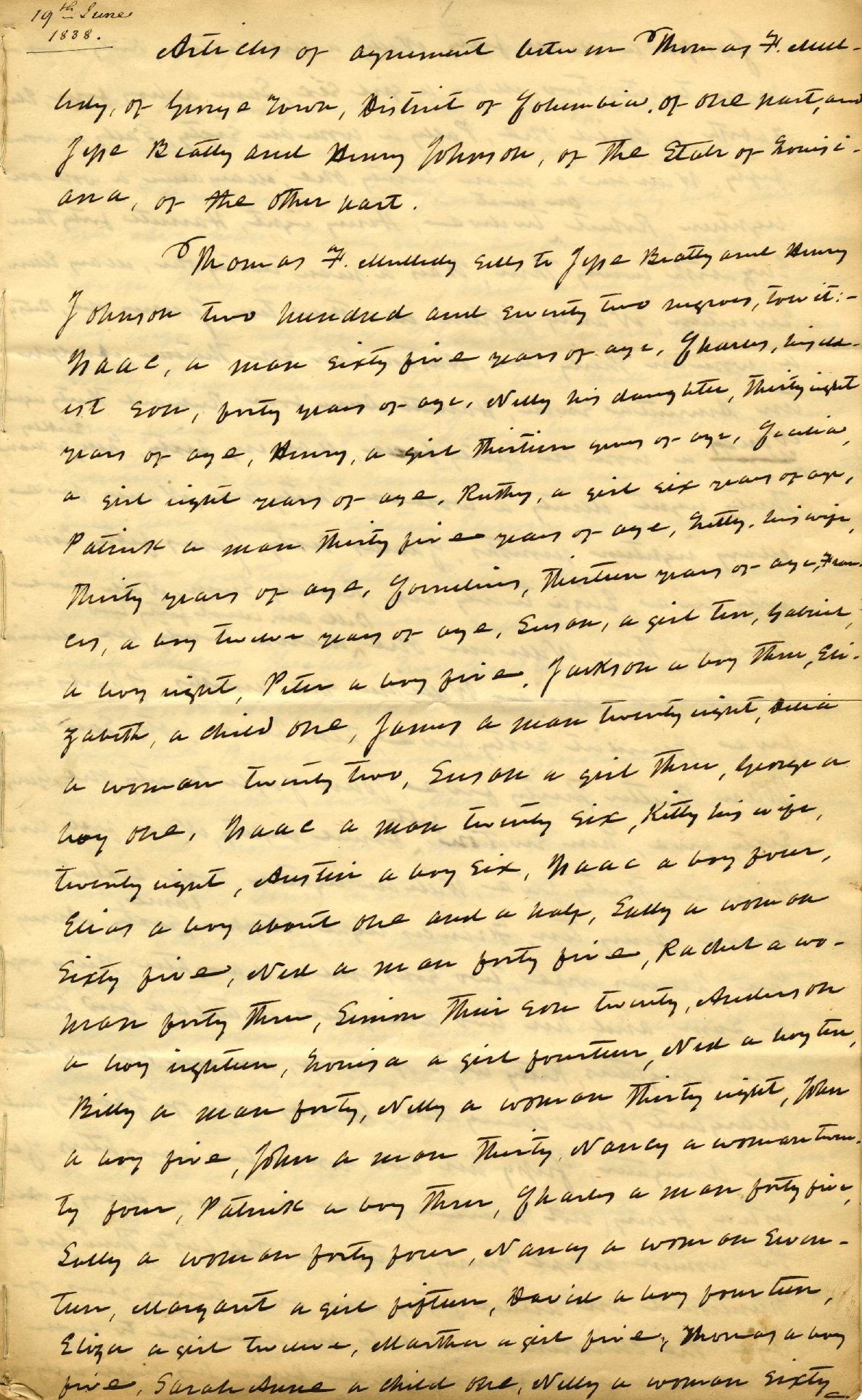
Sale of 272 enslaved people by the Jesuits in Maryland
In 1838 Jesuits sold 272 enslaved people who had worked on the order's plantations in southern Maryland. The proceeds went to the Maryland Province of the Jesuits and paid off debts of Georgetown University. In 2017 the Jesuit order in the United States confessed that its superiors had enslaved the ancestors of the descendants and sold them "mercilessly".
- Period
- 1838 (less than 1 year)
- Acknowledgement by the Church
- 179 years later, on 18 April 2017: „whose leaders enslaved and mercilessly sold your ancestors, stands before you to say“ (Remarks of Fr. Timothy Kesicki, SJ, at Georgetown University’s Liturgy of Remembrance, Contrition, and Hope, Original)
- Country
- United States
- Institutions
- Society of Jesus (Maryland Province)
Georgetown University - Category
- Slavery
- Level of evidence
- A Primary source · what does this mean?

What happened to the people
Who was affected? Victims and numbers
- In 1838, 272 enslaved people who worked on Jesuit plantations in southern Maryland were sold. The proceeds went to the Maryland Province of the Jesuits and served to pay off debts of Georgetown University.
Evidence: Georgetown University (Jesuitenuniversität), Absatz 3
„the 1838 sale of 272 enslaved people who worked on Jesuit plantations in southern Maryland. Proceeds of the sale went to the Maryland Province of Jesuits and were used to pay off debts at Georgetown“
Georgetown Shares Slavery, Memory, and Reconciliation Report, Racial Justice Steps, Absatz 3. Original
What happened to those affected?
- In the autumn of 1838 those sold were taken by ship to Louisiana and had to work on cotton and sugar plantations under terrible conditions. Many were sold on, some several times. A Jesuit who visited the plantations in 1848 reported that the owners had neglected their religious instruction.
Evidence: Georgetown University (Jesuitenuniversität), Kap. The Sale of 1838, S. 15 (PDF-S. 23)
„The manifest of one of the vessels on which the slaves were transported to Louisiana in the fall of 1838 has been found“
Report of the Working Group on Slavery, Memory, and Reconciliation to the President of Georgetown University, Kap. The Sale of 1838, S. 15 (PDF-S. 23). Original · Archive copy Evidence: Georgetown University (Jesuitenuniversität), Kap. After the Sale, S. 16 (PDF-S. 24)
„what happened to the people who were sold to Louisiana, where they labored under dreadful conditions on cotton and sugar plantations. Many were sold again.“
Report of the Working Group on Slavery, Memory, and Reconciliation to the President of Georgetown University, Kap. After the Sale, S. 16 (PDF-S. 24). Original · Archive copy Evidence: Georgetown University (Jesuitenuniversität), Kap. After the Sale, S. 16 (PDF-S. 24)
„he reported that their owners had neglected their religious instruction“
Report of the Working Group on Slavery, Memory, and Reconciliation to the President of Georgetown University, Kap. After the Sale, S. 16 (PDF-S. 24). Original · Archive copy
Background
Why? Justification and motives (according to the sources)
- The proceeds of the sale served to pay off debts of Georgetown University.
Evidence: Georgetown University (Jesuitenuniversität), Absatz 3
„Proceeds of the sale went to the Maryland Province of Jesuits and were used to pay off debts at Georgetown“
Georgetown Shares Slavery, Memory, and Reconciliation Report, Racial Justice Steps, Absatz 3. Original
Who received the assets, who profited?
- The proceeds went to the Maryland Province of the Jesuits.
Evidence: Georgetown University (Jesuitenuniversität), Absatz 3
„Proceeds of the sale went to the Maryland Province of Jesuits“
Georgetown Shares Slavery, Memory, and Reconciliation Report, Racial Justice Steps, Absatz 3. Original - In June 1838 Father Thomas Mulledy sold the 272 people, listed by name, for 115,000 dollars, payable over ten years, to Henry Johnson, formerly Governor of Louisiana, and the planter Jesse Batey; the buyers mortgaged the people as security. Most of the down payment was used to pay off debts of Georgetown College. According to a Jesuit historian, the sum was paid in full only in 1862.
Evidence: Georgetown University (Jesuitenuniversität), Kap. The Sale of 1838, S. 15 (PDF-S. 23)
„for the price of $115,000 (roughly $3.3 million today when adjusted for inflation) to be paid over ten years“
Report of the Working Group on Slavery, Memory, and Reconciliation to the President of Georgetown University, Kap. The Sale of 1838, S. 15 (PDF-S. 23). Original · Archive copy Evidence: Georgetown University (Jesuitenuniversität), Kap. The Sale of 1838, S. 15 (PDF-S. 23)
„Moreover, the buyers mortgaged the slaves as collateral.“
Report of the Working Group on Slavery, Memory, and Reconciliation to the President of Georgetown University, Kap. The Sale of 1838, S. 15 (PDF-S. 23). Original · Archive copy Evidence: Georgetown University (Jesuitenuniversität), Kap. After the Sale, S. 16 (PDF-S. 24)
„We know that most of the down payment was used to solve a serious problem of debt at the College.“
Report of the Working Group on Slavery, Memory, and Reconciliation to the President of Georgetown University, Kap. After the Sale, S. 16 (PDF-S. 24). Original · Archive copy Evidence: Georgetown University (Jesuitenuniversität), Kap. After the Sale, S. 16 (PDF-S. 24)
„the total sum was not paid in full until 1862“
Report of the Working Group on Slavery, Memory, and Reconciliation to the President of Georgetown University, Kap. After the Sale, S. 16 (PDF-S. 24). Original · Archive copy
Response of the Church
- On 18 April 2017 the president of the Jesuit Conference confessed on behalf of the order in the United States that its superiors had enslaved the ancestors of those present and sold them mercilessly.
Evidence: Jesuitenkonferenz Kanada und USA, Einleitung
„on behalf of the Society of Jesus in the United States, at the Georgetown University Liturgy of Remembrance, Contrition, and Hope on April 18, 2017“
Remarks of Fr. Timothy Kesicki, SJ, at Georgetown University’s Liturgy of Remembrance, Contrition, and Hope, Einleitung. Original Evidence: Jesuitenkonferenz Kanada und USA, Absatz 1
„whose leaders enslaved and mercilessly sold your ancestors“
Remarks of Fr. Timothy Kesicki, SJ, at Georgetown University’s Liturgy of Remembrance, Contrition, and Hope, Absatz 1. Original - He spoke of the ownership of human beings that culminated in the sale of 272 men, women and children.
Evidence: Jesuitenkonferenz Kanada und USA, Absatz 3
„It is our very enslavement of another, the very ownership of another, culminating in the tragic sale of 272 men, women, and children“
Remarks of Fr. Timothy Kesicki, SJ, at Georgetown University’s Liturgy of Remembrance, Contrition, and Hope, Absatz 3. Original - The Jesuit leadership in Rome at first leaned towards some form of emancipation, but gave way after strong pressure from American Jesuits. It attached conditions to the sale: families were not to be separated, the baptised were to be able to continue practising their Catholic faith, and the proceeds were to serve as endowment capital, not to pay off debts. According to the Georgetown report, none of these conditions was met.
Evidence: Georgetown University (Jesuitenuniversität), Kap. Slavery, S. 14 (PDF-S. 22)
„Their initial inclinations were toward some form of emancipation. Following extensive lobbying by American Jesuits, they capitulated to those who argued for sale.“
Report of the Working Group on Slavery, Memory, and Reconciliation to the President of Georgetown University, Kap. Slavery, S. 14 (PDF-S. 22). Original · Archive copy Evidence: Georgetown University (Jesuitenuniversität), Kap. Slavery, S. 14 (PDF-S. 22)
„In the end, none of these conditions was fulfilled.“
Report of the Working Group on Slavery, Memory, and Reconciliation to the President of Georgetown University, Kap. Slavery, S. 14 (PDF-S. 22). Original · Archive copy
Original documents to read
- Church document
Georgetown University (Jesuitenuniversität): Georgetown Shares Slavery, Memory, and Reconciliation Report, Racial Justice Steps, 1 September 2016. Original (retrieved 11 Oct 2026) - Church document
Jesuitenkonferenz Kanada und USA: Remarks of Fr. Timothy Kesicki, SJ, at Georgetown University’s Liturgy of Remembrance, Contrition, and Hope, 18 April 2017. Original (retrieved 11 Oct 2026) - Church document
Georgetown University (Jesuitenuniversität): Report of the Working Group on Slavery, Memory, and Reconciliation to the President of Georgetown University, 1 January 2016. Original · Archive copy (retrieved 16 Oct 2026)
Change log (8)
The change log is kept in German only.
- : Aktualisiert: Englische Übersetzung
- : Aktualisiert: Tatsachen, Quellen
- : Aktualisiert: Zusammenfassung
- : Aktualisiert: Tatsachen
- : Aktualisiert: Tatsachen
- : Aktualisiert: Tatsachen
- : Aktualisiert: Tatsachen
- : Aufgenommen
Last changed on 22 October 2026. Is something missing or wrong? Suggest an addition or correction.