 Kirchenakte
750-1440 · 690 years
· show in timeline
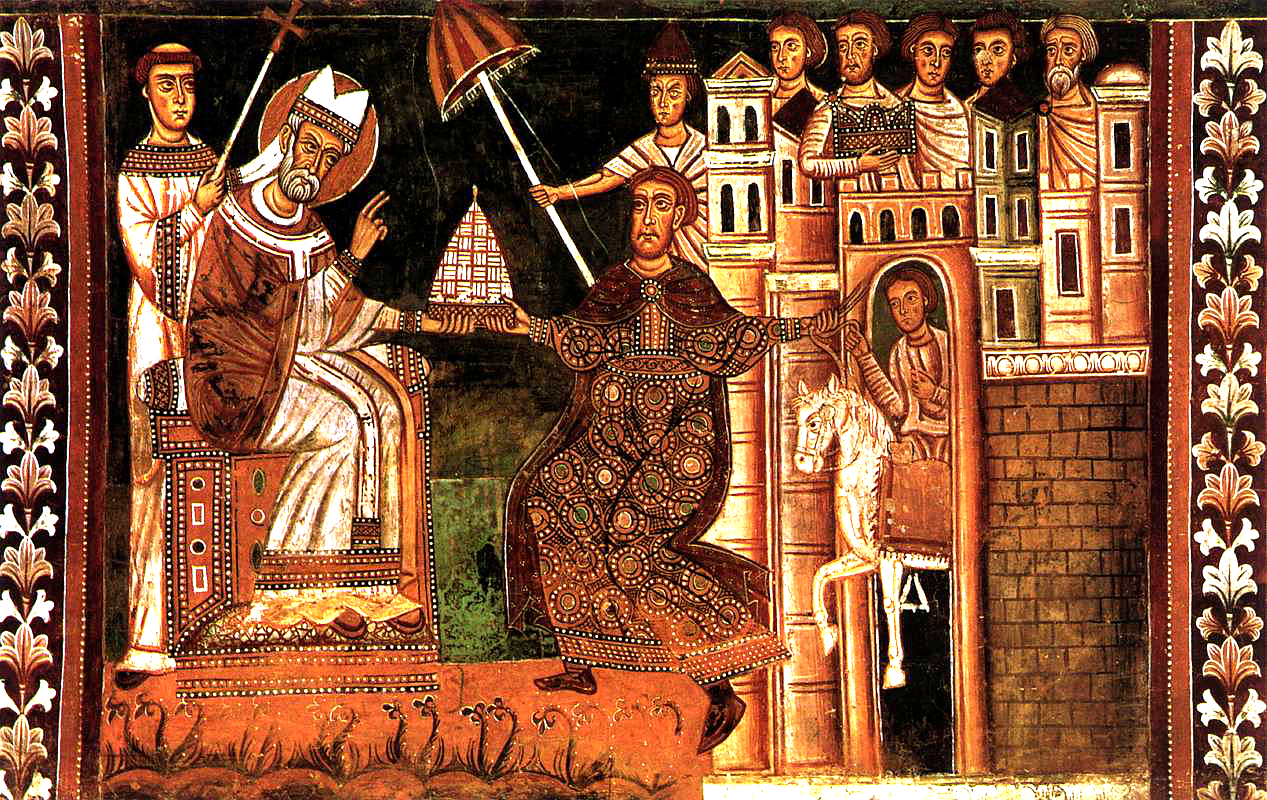
Donation of Constantine, a forged charter on papal rights of rule
The "Donation of Constantine" is a charter in which Emperor Constantine grants Pope Sylvester I and his successors primacy over all bishops, imperial honours, the Lateran Palace as well as Rome, Italy and all western provinces. It was forged between 750 and 850. Where is disputed: the Britannica (1911) places the forgery in Rome, while Catholic scholars argued for an origin in the Frankish kingdom. From the 11th century popes based claims on it, and the charter was part of canon law. Lorenzo Valla proved the forgery in 1440; it was still defended until the end of the 18th century.
- Period
- 750-1440 (690 years)
- Country
- France, Italy, Vatican City
- Institutions
- Papacy
Canon law - Category
- Forgery
- Level of evidence
- B two independent scholarly sources · what does this mean?
- Persons
- Constantine the Great (Roman emperor, purported issuer of the forged charter)
Lorenzo Valla (humanist, proved the forgery in 1440)
Cardinal Baronius (church historian, admitted the forgery)

What happened to the people
What happened to those affected?
- Lorenzo Valla proved the forgery conclusively in 1440. Its authenticity was nevertheless still defended and the charter continued to be used as genuine until Cardinal Baronius admitted it was a forgery; according to the Britannica, the defence fell silent only at the end of the 18th century.
Evidence: The Catholic Encyclopedia, Bd. 5 (1909), Artikel Donation of Constantine
„Lorenzo Valla (De falso credita et ementita Constantini donatione declamatio, Mainz, 1518) proved the forgery with certainty“
Donation of Constantine, Artikel Donation of Constantine. Original · Archive copy Evidence: The Catholic Encyclopedia, Bd. 5 (1909), Artikel Donation of Constantine
„Its genuinity was yet occasionally defended, and the document still further used as authentic, until Baronius“
Donation of Constantine, Artikel Donation of Constantine. Original · Archive copy Evidence: Encyclopædia Britannica, 11. Auflage, Bd. 8 (1911), Wikisource, Artikel Donation of Constantine
„opened a controversy that lasted until, at the close of the 18th century, the defence was silenced“
Donation of Constantine, Artikel Donation of Constantine. Original
Background
Course of events
- In the charter, Emperor Constantine grants the pope and his successors the Lateran Palace, the city of Rome and all provinces, places and cities of Italy and the western regions; the pope receives the same honours as the emperor, including the crown and the purple.
Evidence: The Catholic Encyclopedia, Bd. 5 (1909), Artikel Donation of Constantine, Inhalt
„the emperor makes a present to the pope and his successors of the Lateran palace, of Rome and the provinces, districts, and towns of Italy and all the Western regions“
Donation of Constantine, Artikel Donation of Constantine, Inhalt. Original · Archive copy Evidence: The Catholic Encyclopedia, Bd. 5 (1909), Artikel Donation of Constantine, Inhalt
„The pope shall enjoy the same honorary rights as the emperor, among them the right to wear an imperial crown, a purple cloak and tunic“
Donation of Constantine, Artikel Donation of Constantine, Inhalt. Original · Archive copy - The Catholic Encyclopedia calls the document undoubtedly a forgery, made between 750 and 850; the Britannica speaks of a clumsy forgery.
Evidence: The Catholic Encyclopedia, Bd. 5 (1909), Artikel Donation of Constantine
„This document is without doubt a forgery, fabricated somewhere between the years 750 and 850.“
Donation of Constantine, Artikel Donation of Constantine. Original · Archive copy Evidence: Encyclopædia Britannica, 11. Auflage, Bd. 8 (1911), Wikisource, Artikel Donation of Constantine
„It is now universally admitted to be a gross forgery.“
Donation of Constantine, Artikel Donation of Constantine. Original
Why? Justification and motives (according to the sources)
- Where and by whom it was forged is disputed. The Britannica (1911) writes that the charter was forged in Rome and that its style corresponds to that of the papal chancery in the second half of the 8th century; one interpretation sees it as a legal basis for the rule of Pope Hadrian I in Italy. The Catholic Encyclopedia, by contrast, following Hergenröther and Grauert, considers an origin in the Frankish kingdom defensible, as a justification for the imperial coronation of Charlemagne.
Evidence: Encyclopædia Britannica, 11. Auflage, Bd. 8 (1911), Wikisource, Artikel Donation of Constantine
„was forged at Rome some time between the middle and end of the 8th century“
Donation of Constantine, Artikel Donation of Constantine. Original Evidence: Encyclopædia Britannica, 11. Auflage, Bd. 8 (1911), Wikisource, Artikel Donation of Constantine
„the style of the Constitutum is generally that of the papal chancery in the latter half of the 8th century“
Donation of Constantine, Artikel Donation of Constantine. Original Evidence: Encyclopædia Britannica, 11. Auflage, Bd. 8 (1911), Wikisource, Artikel Donation of Constantine
„with the idea of giving a legal basis to territorial dominion which that pope had succeeded in establishing in Italy“
Donation of Constantine, Artikel Donation of Constantine. Original Evidence: The Catholic Encyclopedia, Bd. 5 (1909), Artikel Donation of Constantine
„the chief aim of the forgery was to prove the justice of the translatio imperii to the Franks“
Donation of Constantine, Artikel Donation of Constantine. Original · Archive copy
Who received the assets, who profited?
- Popes Gregory V and Sylvester II invoked the charter to enforce territorial claims. Pope Leo IX made it the basis of more far-reaching papal claims against Byzantium, in 1050 according to the Britannica, in 1054 according to the Catholic Encyclopedia. From the 12th century, according to the Britannica, it became a powerful weapon of the spiritual against the secular powers.
Evidence: Encyclopædia Britannica, 11. Auflage, Bd. 8 (1911), Wikisource, Artikel Donation of Constantine
„it was employed by two Frankish popes, Gregory V. and Silvester II., in urging certain territorial claims“
Donation of Constantine, Artikel Donation of Constantine. Original Evidence: Encyclopædia Britannica, 11. Auflage, Bd. 8 (1911), Wikisource, Artikel Donation of Constantine
„But not till 1050 was it made the basis of the larger papal claims, when another Frankish pope, Leo IX., used it in his controversy with the Byzantines.“
Donation of Constantine, Artikel Donation of Constantine. Original Evidence: The Catholic Encyclopedia, Bd. 5 (1909), Artikel Donation of Constantine
„The first certain use of it at Rome was by Leo IX in 1054“
Donation of Constantine, Artikel Donation of Constantine. Original · Archive copy Evidence: Encyclopædia Britannica, 11. Auflage, Bd. 8 (1911), Wikisource, Artikel Donation of Constantine
„from the 12th century onwards became a powerful weapon of the spiritual against the temporal powers“
Donation of Constantine, Artikel Donation of Constantine. Original
Response of the Church
- In the 9th century the charter was included in the Pseudo-Isidorian Decretals and two centuries later in the Decretum, the authoritative collection of canon law; as late as the 18th century it was still among the provisions of canon law.
Evidence: Encyclopædia Britannica, 11. Auflage, Bd. 8 (1911), Wikisource, Artikel Donation of Constantine
„was included in the 9th century in the collection known as the False Decretals, two centuries later was incorporated in the Decretum by a pupil of Gratian“
Donation of Constantine, Artikel Donation of Constantine. Original Evidence: Encyclopædia Britannica, 11. Auflage, Bd. 8 (1911), Wikisource, Artikel Donation of Constantine
„enrolled among the decrees of the canon law“
Donation of Constantine, Artikel Donation of Constantine. Original
Scholarly literature and reference works
- Reference work
The Catholic Encyclopedia, Bd. 5 (1909): Donation of Constantine, 1 January 1909. Original · Archive copy (retrieved 12 Oct 2026) - Reference work
Encyclopædia Britannica, 11. Auflage, Bd. 8 (1911), Wikisource: Donation of Constantine, 1 January 1911. Original (retrieved 12 Oct 2026)
Change log (3)
The change log is kept in German only.
- : Aktualisiert: Englische Übersetzung
- : Aktualisiert: Personen
- : Aufgenommen
Last changed on 22 October 2026. Is something missing or wrong? Suggest an addition or correction.