 Kirchenakte
1204 · less than 1 year
· show in timeline
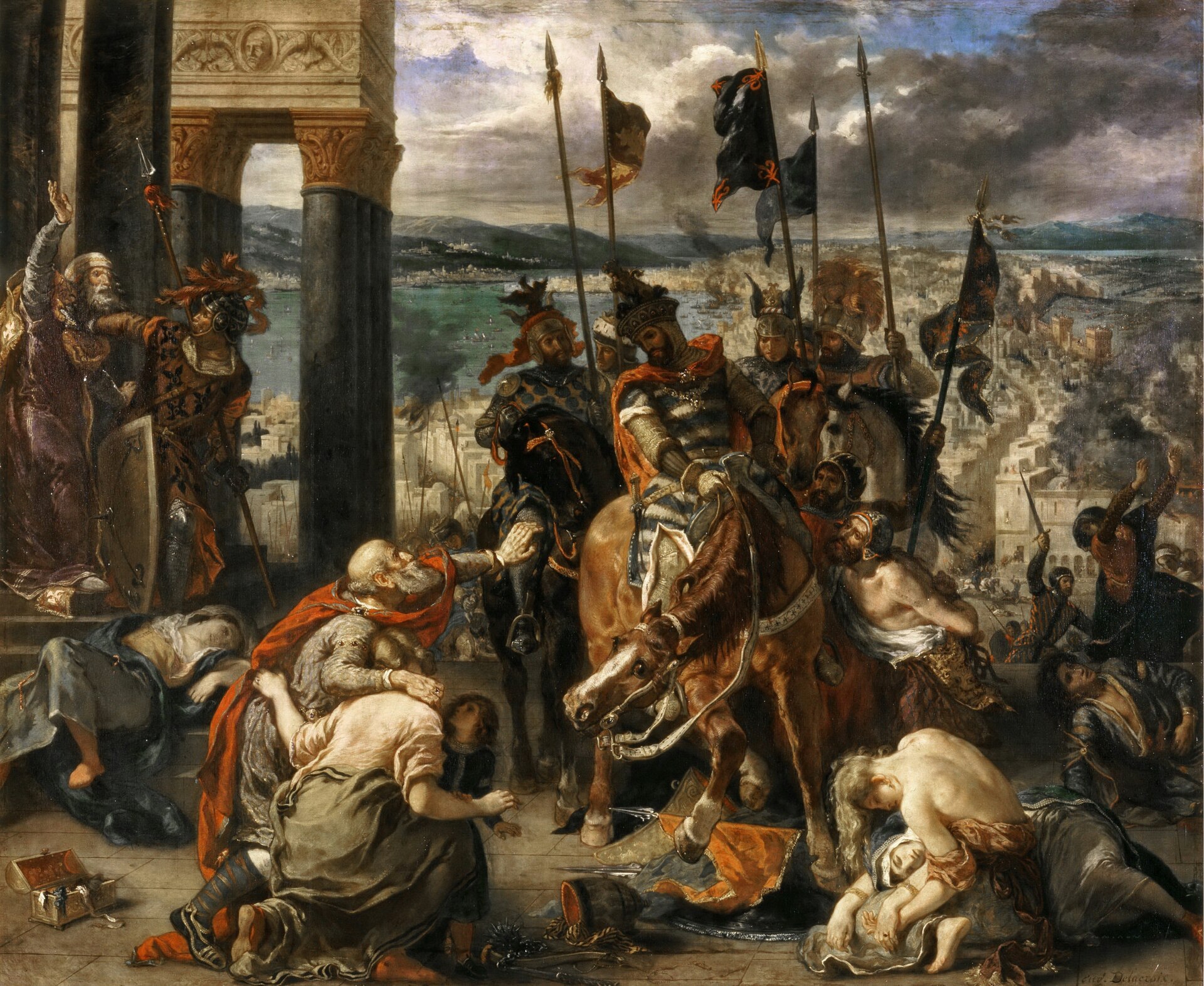
Sack of Constantinople in the Fourth Crusade
In the Fourth Crusade in 1204, crusaders captured and plundered Constantinople, the capital of the Christian East. In Athens in 2001 Pope John Paul II called the sack devastating and tragic and asked forgiveness for the sins of Catholics against Orthodox Christians.
- Period
- 1204 (less than 1 year)
- Acknowledgement by the Church
- 797 years later, on 4 May 2001: „I am thinking of the disastrous sack of the imperial city of Constantinople“ (Address of John Paul II to His Beatitude Christodoulos, Archbishop of Athens and Primate of Greece, Original)
- Country
- Turkey
- Institutions
- Crusader army of the Fourth Crusade
- Category
- Admission, Violence, Crusade
- Level of evidence
- A Primary source · what does this mean?
- Persons
- John Paul II (Pope)

What happened to the people
What happened to those affected?
- On 12 April 1204 the city was stormed, and the next day the ruthless plundering of churches and palaces began. Ancient masterpieces were destroyed; clerics and knights took part in plundering the churches in order to seize famous relics. Venice received half of the spoils, and most churches of the West were enriched with ornaments from the churches of Constantinople.
Evidence: The Catholic Encyclopedia, Bd. 4 (1908), Abschnitt „The crusade against Constantinople (1204)“
„On 12 April, 1204, Constantinople was carried by storm, and the next day the ruthless plundering of its churches and palaces was begun. The masterpieces of antiquity, piled up in public places and in the Hippodrome, were utterly destroyed. Clerics and knights , in their eagerness to acquire famous and priceless relics , took part in the sack of the churches. The Venetians received half the booty“
Crusades, Abschnitt „The crusade against Constantinople (1204)“. Original Evidence: The Catholic Encyclopedia, Bd. 4 (1908), Abschnitt „The crusade against Constantinople (1204)“
„most of the churches of the West were enriched with ornaments stripped from those of Constantinople“
Crusades, Abschnitt „The crusade against Constantinople (1204)“. Original
Background
Course of events
- In the Fourth Crusade, Constantinople was taken in 1204.
Evidence: The Catholic Encyclopedia, Bd. 4 (1908), Abschnitt „Division“
„the fourth, during which Constantinople was taken, 1204“
Crusades, Abschnitt „Division“. Original
Why? Justification and motives (according to the sources)
- As early as March 1204, the Venetians and the crusade leaders agreed by treaty on the division of the spoils. The Britannica names "Venetian cupidity" as the driving force and writes that in the Fourth Crusade the political and commercial motives openly became dominant.
Evidence: The Catholic Encyclopedia, Bd. 4 (1908), Abschnitt „The crusade against Constantinople (1204)“
„By a treaty concluded in March, 1204, between the Venetians and the crusading chiefs, it was pre-arranged to share the spoils of the Greek Empire“
Crusades, Abschnitt „The crusade against Constantinople (1204)“. Original Evidence: Encyclopædia Britannica, 11. Auflage (1911), Abschnitt „The Fourth Crusade“
„the political and commercial motives, which were deeply implicit even in the First Crusade, had now become dominantly explicit“
Crusades, Abschnitt „The Fourth Crusade“. Original · Archive copy Evidence: Encyclopædia Britannica, 11. Auflage (1911), Abschnitt „The Fourth Crusade“
„If Venetian cupidity had not originally deflected the Crusade“
Crusades, Abschnitt „The Fourth Crusade“. Original · Archive copy
Who received the assets, who profited?
- The crusaders had promised Venice 85,000 marks and half of the conquests for passage and assistance. When they could not raise the money in 1202, they conquered the Christian city of Zara for Venice to settle the debt (November 1202). The pretender to the throne Alexius promised them 200,000 marks if they brought him to Constantinople.
Evidence: Encyclopædia Britannica, 11. Auflage (1911), Abschnitt „The Fourth Crusade“
„transport and active help were to be given by Venice in return for 85,000 marks and the cession of half of the conquests made by the crusaders“
Crusades, Abschnitt „The Fourth Crusade“. Original · Archive copy Evidence: Encyclopædia Britannica, 11. Auflage (1911), Abschnitt „The Fourth Crusade“
„it was found impossible to get together the 85,000 marks promised to Venice“
Crusades, Abschnitt „The Fourth Crusade“. Original · Archive copy Evidence: The Catholic Encyclopedia, Bd. 4 (1908), Abschnitt „The crusade against Constantinople (1204)“
„the crusaders assembled at Venice could not pay the amount called for by their contract, so, by way of exchange, the Venetians suggested that they help recover the city of Zara in Dalmatia“
Crusades, Abschnitt „The crusade against Constantinople (1204)“. Original Evidence: The Catholic Encyclopedia, Bd. 4 (1908), Abschnitt „The crusade against Constantinople (1204)“
„give the crusaders 200,000 marks“
Crusades, Abschnitt „The crusade against Constantinople (1204)“. Original
Response of the Church
- On 4 May 2001 in Athens, John Paul II spoke of the disastrous sacking of Constantinople and called it tragic that the crusaders turned against their own brothers in the faith.
Evidence: Heiliger Stuhl, Überschrift
„ARCHBISHOP OF ATHENS AND PRIMATE OF GREECE Friday, 4 May 2001“
Address of John Paul II to His Beatitude Christodoulos, Archbishop of Athens and Primate of Greece, Überschrift. Original Evidence: Heiliger Stuhl, Nr. 2
„I am thinking of the disastrous sack of the imperial city of Constantinople, which was for so long the bastion of Christianity in the East. It is tragic that the assailants, who had set out to secure free access for Christians to the Holy Land, turned against their own brothers in the faith“
Address of John Paul II to His Beatitude Christodoulos, Archbishop of Athens and Primate of Greece, Nr. 2. Original - He asked forgiveness for the sins of Catholics against Orthodox Christians.
Evidence: Heiliger Stuhl, Nr. 2
„when sons and daughters of the Catholic Church have sinned by action or omission against their Orthodox brothers and sisters, may the Lord grant us the forgiveness we beg of him“
Address of John Paul II to His Beatitude Christodoulos, Archbishop of Athens and Primate of Greece, Nr. 2. Original - Innocent III had forbidden the expedition to Constantinople, but the crusaders received absolution for the conquest of Zara. After the fall of the city he confirmed the subjugation, as the Britannica writes "dazzled by the magic of the fait accompli"; a Venetian became Latin Patriarch.
Evidence: Encyclopædia Britannica, 11. Auflage (1911), Abschnitt „The Fourth Crusade“
„in spite of Innocent’s renewed prohibitions“
Crusades, Abschnitt „The Fourth Crusade“. Original · Archive copy Evidence: The Catholic Encyclopedia, Bd. 4 (1908), Abschnitt „The crusade against Constantinople (1204)“
„Having obtained absolution for the capture of Zara“
Crusades, Abschnitt „The crusade against Constantinople (1204)“. Original Evidence: Encyclopædia Britannica, 11. Auflage (1911), Abschnitt „The Fourth Crusade“
„The crusaders appealed to Innocent to ratify the subjugation of a schismatic people, and the union of the Eastern and Western Churches; and Innocent, dazzled by the magic of the fait accompli , not unwillingly acquiesced.“
Crusades, Abschnitt „The Fourth Crusade“. Original · Archive copy
See also
-
1095-1291 · 196 years
Crusades to the East
- Germany
- France
- Israel
- Lebanon
- Palestine
- Syria
- Turkey
- Anti-Judaism
- Violence
- Crusade
- Murder
Original documents to read
- Church document
Heiliger Stuhl: Address of John Paul II to His Beatitude Christodoulos, Archbishop of Athens and Primate of Greece, 4 May 2001. Original (retrieved 11 Oct 2026)
Scholarly literature and reference works
- Reference work
The Catholic Encyclopedia, Bd. 4 (1908): Crusades, 1 January 1908. Original (retrieved 11 Oct 2026) - Reference work
Encyclopædia Britannica, 11. Auflage (1911): Crusades, 1 January 1911. Original · Archive copy (retrieved 11 Oct 2026)
Change log (5)
The change log is kept in German only.
- : Aktualisiert: Englische Übersetzung
- : Aktualisiert: Tatsachen, Quellen
- : Aktualisiert: Tatsachen
- : Aktualisiert: Tatsachen
- : Aufgenommen
Last changed on 22 October 2026. Is something missing or wrong? Suggest an addition or correction.