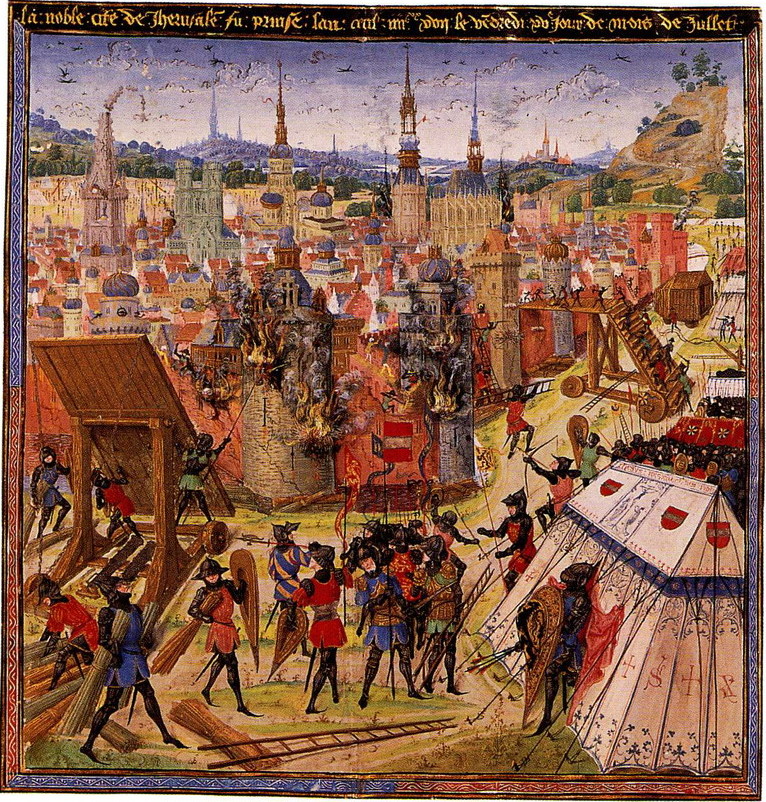
On 26 November 1095 at Clermont, Pope Urban II called for the First Crusade. When they captured Jerusalem in July 1099, the crusaders killed the inhabitants regardless of age or sex. With the fall of Acre in 1291 the Kingdom of Jerusalem came to an end.
Deaths
about 4,000(estimated, Jews in the Rhineland in 1096, killed or driven to their deaths)Evidence: Jewish Encyclopedia (1901–1906)
„it has been calculated that about 4,000 were killed or slew themselves“
Crusades, The (Richard Gottheil, Joseph Jacobs). Original
Period
1095-1291 (196 years)
Country
Germany, France, Israel, Lebanon, Palestine, Syria, Turkey
Urban II (Pope) Godfrey of Bouillon (crusade leader) Egbert of Trier (Archbishop of Trier) Hermann of Cologne (Archbishop of Cologne, tried to protect the Jews) John of Speyer (Bishop of Speyer, tried to protect the Jews)
Capture of Jerusalem in the First Crusade in 1099, late medieval book illumination
Image: unbekannt,
Public domain,
Source
What happened to the people
Who was affected? Victims and numbers
After the assault of 14 July 1099, the crusaders broke into Jerusalem the next day and killed the inhabitants regardless of age or sex.
Evidence: The Catholic Encyclopedia, Bd. 4 (1908), Abschnitt „Foundation of Christian states in the East“
„the attack began 14 July, 1099. Next day the Christians entered Jerusalem from all sides and slew its inhabitants regardless of age or sex“
Crusades, Abschnitt „Foundation of Christian states in the East“.
Original
Already on the way to the First Crusade in 1096, crusaders attacked the Jewish communities on the Rhine: 22 dead in Metz, 11 in Speyer, according to tradition 800 in Worms (400 known by name), 1,014 in Mainz, 200 in Neuss and Altenahr. In total about 4,000 Jews in the Rhineland were killed or killed themselves.
Evidence: Jewish Encyclopedia (1901–1906), Abschnitt „First Crusade: 1096“
„In the spring of 1096 twenty-two Jews were slain at Metz, and on May 3 the crusaders and accompanying rabble attacked the Jews of Speyer, slaying eleven of them“
Crusades, The (Richard Gottheil, Joseph Jacobs), Abschnitt „First Crusade: 1096“.
OriginalEvidence: Jewish Encyclopedia (1901–1906), Abschnitt „First Crusade: 1096“
„The number of the slain is said to have amounted to 800, though the extant list of names reaches only 400“
Crusades, The (Richard Gottheil, Joseph Jacobs), Abschnitt „First Crusade: 1096“.
OriginalEvidence: Jewish Encyclopedia (1901–1906), Abschnitt „Mayence“
„The corpses after being stripped were cast into nine graves; they are said to have numbered 1,014“
Crusades, The (Richard Gottheil, Joseph Jacobs), Abschnitt „Mayence“.
OriginalEvidence: Jewish Encyclopedia (1901–1906), Abschnitt „Mayence“
„killing 200 in Neuss and Altenahr, in several cases throwing old women and young children into the river“
Crusades, The (Richard Gottheil, Joseph Jacobs), Abschnitt „Mayence“.
OriginalEvidence: Jewish Encyclopedia (1901–1906), Abschnitt „Mayence“
„it has been calculated that about 4,000 were killed or slew themselves“
Crusades, The (Richard Gottheil, Joseph Jacobs), Abschnitt „Mayence“.
Original
When Jerusalem was captured in 1099, the crusaders drove all the Jews into a synagogue and burned them alive.
Evidence: Jewish Encyclopedia (1901–1906), Abschnitt „Mayence“
„When the crusaders at last stormed Jerusalem, July 15, 1099, they drove all the Jews into one of the synagogues and there burned them alive“
Crusades, The (Richard Gottheil, Joseph Jacobs), Abschnitt „Mayence“.
Original
What happened to those affected?
In Worms the houses were destroyed and even the corpses were plundered; many killed themselves so as not to fall into the hands of the mob. One man was buried alive with his whole family while the mob offered them rescue if they would be baptised.
Evidence: Jewish Encyclopedia (1901–1906), Abschnitt „First Crusade: 1096“
„Their houses were destroyed, and even the corpses denuded. Many slew themselves rather than fall into the hands of the mob“
Crusades, The (Richard Gottheil, Joseph Jacobs), Abschnitt „First Crusade: 1096“.
OriginalEvidence: Jewish Encyclopedia (1901–1906), Abschnitt „First Crusade: 1096“
„Mar Shemariah with his whole family was buried alive amid the jeers of the mob, who nevertheless during the entombment offered in vain to grant them safety if they would become converted“
Crusades, The (Richard Gottheil, Joseph Jacobs), Abschnitt „First Crusade: 1096“.
Original
Many were forcibly baptised. In Trier, Archbishop Egbert gave the Jews the choice between baptism and death and handed some over to the crusaders, who killed them at once; other bishops such as John of Speyer and Hermann of Cologne tried to protect them. When the emperor allowed those forcibly baptised to return to Judaism, Pope Clement III protested.
Evidence: Jewish Encyclopedia (1901–1906), Abschnitt „Mayence“
„he told the Jews there was no hope for their lives but in baptism. When they still remained obdurate some of them were exposed by him to the crusaders, who immediately slew them“
Crusades, The (Richard Gottheil, Joseph Jacobs), Abschnitt „Mayence“.
OriginalEvidence: Jewish Encyclopedia (1901–1906), Abschnitt „First Crusade: 1096“
„only being restrained by the exertions of Bishop John from putting them all to death in the synagogue“
Crusades, The (Richard Gottheil, Joseph Jacobs), Abschnitt „First Crusade: 1096“.
OriginalEvidence: Jewish Encyclopedia (1901–1906), Abschnitt „Mayence“
„he granted them permission to revert to their ancestral faith (Pertz, "Monumenta," ii. 181), notwithstanding the protests of Pope Clement III.“
Crusades, The (Richard Gottheil, Joseph Jacobs), Abschnitt „Mayence“.
Original
Background
Course of events
On 26 November 1095 at Clermont, Pope Urban II called for the First Crusade.
Evidence: Encyclopædia Britannica, 11. Auflage (1911), Abschnitt „First Crusade“
„he moved to Clermont, in the S.E. of France, and there on the 26th of November delivered the great speech which was followed by the First Crusade“
Crusades, Abschnitt „First Crusade“.
Original · Archive copyEvidence: The Catholic Encyclopedia, Bd. 4 (1908), Abschnitt „Origin of the Crusades“
„The idea of the crusade is chiefly attributed to Pope Urban II (1095)“
Crusades, Abschnitt „Origin of the Crusades“.
Original
Traditionally eight crusades are counted, the first from 1095 to 1101.
Evidence: The Catholic Encyclopedia, Bd. 4 (1908), Abschnitt „Division“
„It has been customary to describe the Crusades as eight in number: the first, 1095-1101“
In 1291 Acre was conquered; with it the Kingdom of Jerusalem came to an end.
Evidence: Encyclopædia Britannica, 11. Auflage (1911), Abschnitt zum Ende der Kreuzfahrerstaaten
„Acre, which was captured after a brave defence by his son and successor Khālil in 1291. Thus the kingdom of Jerusalem came to an end“
Crusades, Abschnitt zum Ende der Kreuzfahrerstaaten.
Original · Archive copyEvidence: The Catholic Encyclopedia, Bd. 4 (1908), Gliederung
„Final loss of the Christian colonies of the East (1254-91)“
Why? Justification and motives (according to the sources)
Urban II called for help for the Greeks, but at its core for the conquest of Jerusalem; the campaign was to count as complete penance.
Evidence: Encyclopædia Britannica, 11. Auflage (1911), Abschnitt „First Crusade“
„let the arms of Christians be directed to the winning of Jerusalem in an expedition which should count for full and complete penance“
According to the Britannica, the knight could thus wage war under the protection and at the command of the Church and in doing so obtain complete salvation and remission of sins.
Evidence: Encyclopædia Britannica, 11. Auflage (1911), Abschnitt zu den Motiven
„under the aegis and at the bidding of the Church; and in so doing he would also attain what the spiritual side of his nature ardently sought—a perfect salvation and remission of sins“
The Jewish communities of Cologne and Mainz each paid the crusade leader Godfrey of Bouillon 500 marks of silver to buy his protection.
Evidence: Jewish Encyclopedia (1901–1906), Abschnitt „First Crusade: 1096“
„when Godfrey de Bouillon came to Cologne and Mayence each community made him a present of 500 silver marks to secure his protection“
Crusades, The (Richard Gottheil, Joseph Jacobs), Abschnitt „First Crusade: 1096“.
Original
 Kirchenakte