 Kirchenakte
Fourth Lateran Council: compulsory badge for Jews
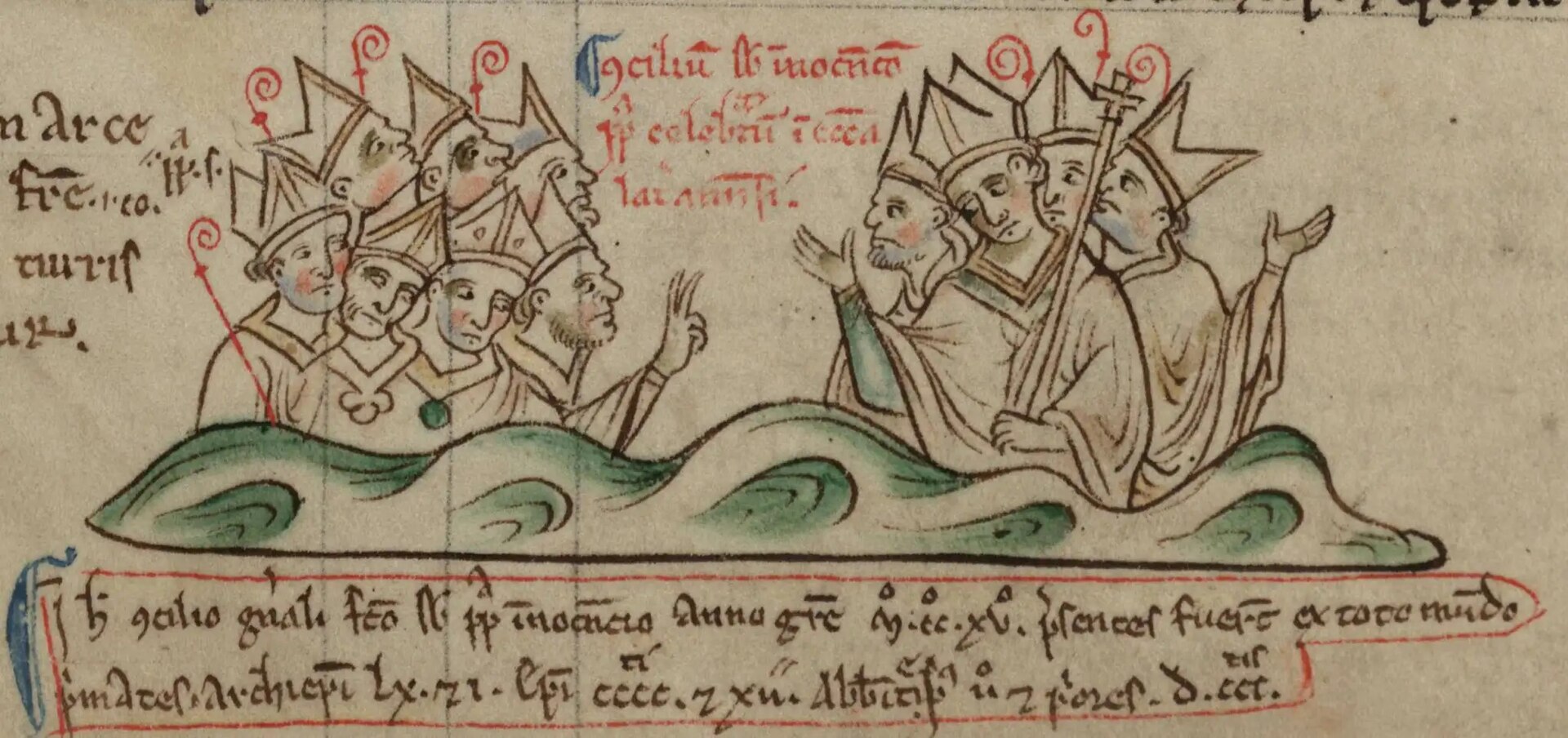
In 1215 the Fourth Lateran Council under Pope Innocent III ordered that Jews and Muslims in all Christian lands must be distinguishable from Christians by their clothing. The reason given was forbidden intercourse with Christian women; according to the Jewish Encyclopedia this was little more than a pretext. Church councils and then kings enforced the badge throughout Europe, usually as a yellow ring. According to the Jewish Encyclopedia the badge contributed substantially to the growing degradation of the Jews; in papal Avignon it was still in force in 1592.
- Period
- 1215-1592 (377 years)
- Country
- Germany, France, Italy, Spain, Hungary, Vatican City, United Kingdom, Austria
- Institutions
- Holy See
Fourth Lateran Council
Provincial councils - Category
- Anti-Judaism, Persecution
- Level of evidence
- B two independent scholarly sources · what does this mean?
- Persons
- Innocent III (Pope)
Stephen Langton (Archbishop of Canterbury)
Louis IX (King of France)

What happened to the people
How were they charged and sentenced?
- In France the Council of Narbonne ordered the ring badge for the whole French Church in 1227; numerous further councils repeated it. The State followed: Louis IX issued a corresponding ordinance in 1269. Anyone found without the badge paid a fine, and Jews had to pay annually for the badges.
Evidence: Jewish Encyclopedia (1901–1906), Cyrus Adler, Joseph Jacobs, Abschnitt In France
„After the Lateran Council it was ordered in the whole of ecclesiastical France at the Council of Narbonne in 1227“
Badge, Abschnitt In France. Original Evidence: Jewish Encyclopedia (1901–1906), Cyrus Adler, Joseph Jacobs, Abschnitt In France
„The state followed the Church in imposing the Badge upon the Jews in France. Saint Louis published an ordinance to that effect (June 19, 1269)“
Badge, Abschnitt In France. Original Evidence: Jewish Encyclopedia (1901–1906), Cyrus Adler, Joseph Jacobs, Abschnitt In France
„Adding injury to insult, the authorities forced the Jews to pay an annual sum for the use of the badges“
Badge, Abschnitt In France. Original - In England, Archbishop Stephen Langton of Canterbury introduced the badge in 1222. In 1415 Pope Benedict XIII demanded by bull a yellow and red badge, worn on the breast by men and on the forehead by women. In papal Avignon the badge is still attested in 1592.
Evidence: Jewish Encyclopedia (1901–1906), Cyrus Adler, Joseph Jacobs, Abschnitt Spain, Italy, and England
„It was first imposed upon the Jews in England by Stephen Langton, archbishop of Canterbury, in 1222“
Badge, Abschnitt Spain, Italy, and England. Original Evidence: Jewish Encyclopedia (1901–1906), Cyrus Adler, Joseph Jacobs, Abschnitt Spain, Italy, and England
„a bull of Benedict XIII. (May 11, 1415) insisted upon the Jews carrying a yellow and red Badge, the men on their breast, the women on their forehead“
Badge, Abschnitt Spain, Italy, and England. Original Evidence: Jewish Encyclopedia (1901–1906), Cyrus Adler, Joseph Jacobs, Abschnitt In France
„the wearing of the Badge was still kept up at Avignon, which was under the rule of the popes; and evidence of the Badge is found there as late as 1592“
Badge, Abschnitt In France. Original
What happened to those affected?
- According to the Jewish Encyclopedia the badge had disastrous consequences for living together; the growing degradation of the Jews in Christendom was due in large measure to this outward sign, which gave discrimination the official stamp of Church and State.
Evidence: Jewish Encyclopedia (1901–1906), Cyrus Adler, Joseph Jacobs, Einleitung
„The Badge had a most deleterious effect upon their social relations; and the increasing degradation of the position of Jews in Christendom was due in a large measure to this outward sign of separation, which gave the official stamp of both Church and state to the discrimination of social status against the Jew.“
Badge, Einleitung. Original
Background
Course of events
- The council, convened by Innocent III, decreed in canons 68 and 69 that Jews and Muslims must wear special clothing so as to be distinguished from Christians. According to the Jewish Encyclopedia, the badge thereby became a general order of Christendom, at the instigation of Innocent III.
Evidence: The Catholic Encyclopedia, Bd. 9 (1910), Liste der Kanones
„Canons 68, 69: Jews and Moslems shall wear a special dress to enable them to be distinguished from Christians .“
Fourth Lateran Council (1215), Liste der Kanones. Original Evidence: Jewish Encyclopedia (1901–1906), Cyrus Adler, Joseph Jacobs, Einleitung
„This was made a general order of Christendom at the fourth Lateran Council of 1215. At the instigation of Innocent III., the decision of the Council ordered the Jews, in the following terms, to bear a Badge“
Badge, Einleitung. Original
Why? Justification and motives (according to the sources)
- As its reason, the council text states that Christians and Jews or Muslims mixed with one another by mistake. According to the Jewish Encyclopedia this was little more than a pretext; the Church wanted to draw a sharp dividing line between believers and "unbelievers". The badge was the last stage in a series of enactments intended to prevent social relations between Jews and Christians.
Evidence: Jewish Encyclopedia (1901–1906), Cyrus Adler, Joseph Jacobs, Einleitung
„From this it would appear that the motive of the order was to prevent illicit intercourse between Jews and Christian women; but it is scarcely doubtful that this was little more than a pretext, the evidence of such intercourse being only of the slightest“
Badge, Einleitung. Original Evidence: Jewish Encyclopedia (1901–1906), Cyrus Adler, Joseph Jacobs, Einleitung
„the Badge came as the last stage in a series of enactments in the twelfth century, intended to prevent social relations between Jews and Christians“
Badge, Einleitung. Original
Original texts
Contingit interdum quod per errorem christiani Judæorum seu Saracenorum et Judæi seu Saraceni christianorum mulieribus commisceantur. Ne igitur tam damnatæ commixtionis excessus per velamentum erroris hujusmodi, excusationis ulterius possint habere diffugium, statuimus ut tales utriusque sexus in omni christianorum provincia, et omni tempore qualitate habitus publice ab aliis populis distinguantur.
Translation (unofficial)
It sometimes happens that by mistake Christians mix with Jewish or Saracen women, and Jews or Saracens with Christian women. So that the offence of such a damnable mixing can no longer hide behind the excuse of such a mistake, we decree that such persons of both sexes in every Christian province and at all times shall be publicly distinguished from other peoples by the character of their dress.
See also
-
1095-1291 · 196 years
Crusades to the East
- Germany
- France
- Israel
- Lebanon
- Palestine
- Syria
- Turkey
- Anti-Judaism
- Violence
- Crusade
- Murder
-
1555-1870 · 315 years
Ghetto of Rome in the Papal States
- Italy
- Vatican City
- Anti-Judaism
- Persecution
Scholarly literature and reference works
- Reference work
The Catholic Encyclopedia, Bd. 9 (1910): Fourth Lateran Council (1215), 1 January 1910. Original (retrieved 12 Oct 2026) - Reference work
Jewish Encyclopedia (1901–1906), Cyrus Adler, Joseph Jacobs: Badge. Original (retrieved 12 Oct 2026)
Change log (3)
The change log is kept in German only.
- : Aktualisiert: Englische Übersetzung
- : Aktualisiert: Personen
- : Aufgenommen
Last changed on 22 October 2026. Is something missing or wrong? Suggest an addition or correction.