 Kirchenakte
1555-1870 · 315 years
· show in timeline
Ghetto of Rome in the Papal States
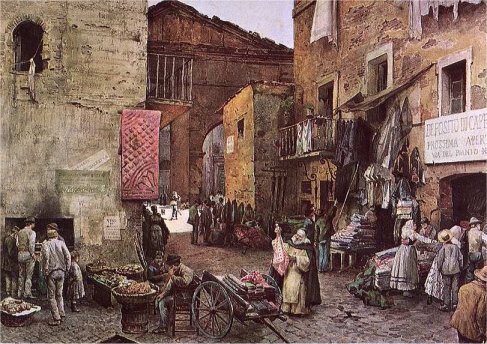
Pope Paul IV had the Jews of Rome gathered in an enclosed quarter and prescribed for them, among other things, a yellow head covering. The ghetto existed until 1870 and was abolished only after the end of the Papal States under Victor Emmanuel; the walls stood until 1885.
- Period
- 1555-1870 (315 years)
- Country
- Italy, Vatican City
- Institutions
- Holy See (Papal States)
- Category
- Anti-Judaism, Persecution
- Level of evidence
- B two independent scholarly sources · what does this mean?
- Persons
- Paul IV (Pope)
Victor Emmanuel (abolished the ghetto in 1870)

What happened to the people
Who was affected? Victims and numbers
- Under Paul IV, David Ascoli, author of a Latin defence of the Jews, was imprisoned. The pope rejected the Jews' offer to pay 40,000 scudi for the revocation of the ordinances.
Evidence: Jewish Encyclopedia (1901–1906), Artikel Rome, Abschnitt Paul IV.
„During his rigorous reign, David Ascoli, the author of a Latin apology, was imprisoned, and the Jews' offer of 40,000 scudi for the revocation of this order was rejected.“
Rome, Artikel Rome, Abschnitt Paul IV.. Original · Archive copy
What happened to those affected?
- Paul IV prescribed a yellow cap and hood for the Jews.
Evidence: Jewish Encyclopedia (1901–1906), Abschnitt „Paul IV.“
„ordered them to wear the yellow cap and hood“
Rome, Abschnitt „Paul IV.“. Original · Archive copy - The Jews had to pay for the ghetto wall themselves; all synagogues but two were condemned.
Evidence: Jewish Encyclopedia (1901–1906), Abschnitt „Paul IV.“
„this street was enclosed by walls, for which the Jews were compelled to pay 100 scudi (Oct. 3). All synagogues, except two, were condemned“
Rome, Abschnitt „Paul IV.“. Original · Archive copy - The ghetto consisted of a few narrow, dirty and unhealthy streets that were soon hopelessly overcrowded, and it lay so low that it was flooded by the Tiber every year.
Evidence: Jewish Encyclopedia (1901–1906), Artikel Ghetto, Abschnitt Rom
„It consisted of a few narrow, dirty, and unhealthful streets, which soon became painfully overcrowded.“
Ghetto, Artikel Ghetto, Abschnitt Rom. Original · Archive copy Evidence: Encyclopædia Britannica, 11. Auflage (1911), Artikel Ghetto
„It lay so low that it was yearly flooded by the Tiber.“
Ghetto, Artikel Ghetto. Original
Background
Course of events
- The sources give different years for its beginning. According to the Jewish Encyclopedia (article Rome), all Jews were driven into one street on 26 July 1555; according to the article Ghetto and the Britannica, they moved into the ghetto in 1556.
Evidence: Jewish Encyclopedia (1901–1906), Abschnitt „Paul IV.“
„On July 26, 1555, all the Jews were herded into one street“
Rome, Abschnitt „Paul IV.“. Original · Archive copy Evidence: Jewish Encyclopedia (1901–1906), Abschnitt „Ghetto in Rome“
„The Roman ghetto was established by Pope Paul IV., and was entered on July 26, 1556“
Ghetto, Abschnitt „Ghetto in Rome“. Original · Archive copy Evidence: Encyclopædia Britannica, 11. Auflage (1911), Absatz 1
„The ghetto at Rome was instituted by Paul IV. in 1556“
Ghetto, Absatz 1. Original - In 1870 the Jews of Rome asked Pope Pius IX to abolish the ghetto; it was abolished by Victor Emmanuel, who entered Rome in the same year.
Evidence: Jewish Encyclopedia (1901–1906), Abschnitt „Ghetto in Rome“
„In 1870 the Jews of Rome presented to Pope Pius IX. a petition for the abolition of the ghetto. But it was reserved for Victor Immanuel, who entered Rome in that year, to fulfil their desire by definitely and finally abolishing the ghetto“
Ghetto, Abschnitt „Ghetto in Rome“. Original · Archive copy Evidence: Encyclopædia Britannica, 11. Auflage (1911), Absatz 1
„In 1870 the Jews petitioned Pius IX. to abolish the ghetto; but it was to Victor Emmanuel that this reform was finally due“
Ghetto, Absatz 1. Original - The walls remained standing until 1885.
Evidence: Encyclopædia Britannica, 11. Auflage (1911), Absatz 1
„The walls remained until 1885“
Ghetto, Absatz 1. Original
Who received the assets, who profited?
- The Jews were forced to sell all their property outside the walls; despite the low prices the sale brought in 500,000 crowns.
Evidence: Jewish Encyclopedia (1901–1906), Abschnitt „Paul IV.“
„the Jews were forced to sell all their property that was situated outside the walls. In spite of the low prices paid, this sale brought 500,000 crowns“
Rome, Abschnitt „Paul IV.“. Original · Archive copy - From March 1556 the Jews had to pay taxes even for the closed synagogues. Every year they had to ask in a humiliating ceremony for permission to live in the ghetto for another year and pay an annual levy for it; according to the Britannica, this levy existed until 1850.
Evidence: Jewish Encyclopedia (1901–1906), Artikel Rome, Abschnitt Paul IV.
„On March 23, 1556 the pope issued an edict according to which the Jews were required to pay taxes for the synagogues that had been closed.“
Rome, Artikel Rome, Abschnitt Paul IV.. Original · Archive copy Evidence: Jewish Encyclopedia (1901–1906), Artikel Ghetto, Abschnitt Rom
„Each year the Jews had to go through the humiliating ceremony of formally imploring permission to continue living there during the ensuing year, for which they paid a yearly tax.“
Ghetto, Artikel Ghetto, Abschnitt Rom. Original · Archive copy Evidence: Encyclopædia Britannica, 11. Auflage (1911), Artikel Ghetto
„The Jews had to sue annually for permission to live there, and paid a yearly tax for the privilege. This formality and tax survived till 1850.“
Ghetto, Artikel Ghetto. Original
See also
-
1215-1592 · 377 years
Fourth Lateran Council: compulsory badge for Jews
- Germany
- France
- Italy
- Spain
- Hungary
- Vatican City
- United Kingdom
- Austria
- Anti-Judaism
- Persecution
-
1233-1966 · 733 years
Book burnings and the Index of Forbidden Books
- France
- Italy
- Spain
- Vatican City
- Anti-Judaism
- Persecution
- Censorship
-
Person 28 Jun 1476-18 Aug 1559 · 83 years old
Pope Paul IV (Gian Pietro Carafa)
- Italy
- Vatican City
- Anti-Judaism
- Expropriation
- Heresy trials
- Persecution
-
1569 · less than 1 year
Bull "Hebraeorum gens" 1569, Pope Pius V expels the Jews from the Papal States
- Italy
- Vatican City
- Anti-Judaism
- Expropriation
- Persecution
-
1577-1847 · 270 years
Compulsory sermons for Jews, Gregory XIII obliges them in 1577 and 1584 to listen to conversion sermons
- Italy
- Vatican City
- Anti-Judaism
- Persecution
Scholarly literature and reference works
- Reference work
Jewish Encyclopedia (1901–1906): Ghetto. Original · Archive copy (retrieved 11 Oct 2026) - Reference work
Jewish Encyclopedia (1901–1906): Rome. Original · Archive copy (retrieved 11 Oct 2026) - Reference work
Encyclopædia Britannica, 11. Auflage (1911): Ghetto, 1 January 1911. Original (retrieved 11 Oct 2026)
Change log (6)
The change log is kept in German only.
- : Aktualisiert: Englische Übersetzung
- : Aktualisiert: Tatsachen
- : Aktualisiert: Personen
- : Aktualisiert: Tatsachen
- : Aktualisiert: Tatsachen
- : Aktualisiert: Tatsachen
Last changed on 22 October 2026. Is something missing or wrong? Suggest an addition or correction.