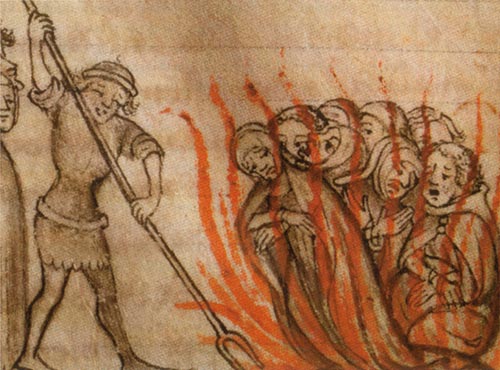
On 13 October 1307 King Philip IV had all Templars in France arrested and interrogated under torture. In 1310, 54 Templars who had retracted their confessions were burned in Paris on the orders of the Archbishop of Sens. Pope Clement V dissolved the order by bull in 1312; in 1314 the Grand Master Jacques de Molay was burned.
Deaths
at least 54(counted, Templars, burned in Paris on 12 May 1310)Evidence: Encyclopædia Britannica, 11. Auflage (1911)
„fifty-four Templars who had retracted their confessions before the commission were burnt in Paris“
Clement V (Pope) Jacques de Molay (Grand Master of the Templars) Philip IV (King of France, ordered the arrest of the Templars)
Burning of Templars, illustration from an anonymous world chronicle, 14th century
Image: unbekannt,
Public domain,
Source
What happened to the people
Who was affected? Victims and numbers
On 12 May 1310, 54 Templars who had retracted their confessions were burned in Paris on the orders of the Archbishop of Sens.
Evidence: Encyclopædia Britannica, 11. Auflage (1911), Abschnitt „The trial“
„fifty-four Templars who had retracted their confessions before the commission were burnt in Paris by order of the archbishop of Sens“
Templars, Abschnitt „The trial“.
OriginalEvidence: The Catholic Encyclopedia, Bd. 14 (1912), Abschnitt zum Prozess
„fifty-four Templars who had recanted after having confessed were condemned as relapsed and publicly burned on 12 May, 1310“
The Knights Templar, Abschnitt zum Prozess.
Original
In 1314 the Grand Master Jacques de Molay was arrested as a relapsed heretic and burned on Philip's orders.
Evidence: Encyclopædia Britannica, 11. Auflage (1911), Schluss
„The final act of the stupendous tragedy came early in 1314“
Templars, Schluss.
OriginalEvidence: The Catholic Encyclopedia, Bd. 14 (1912), Abschnitt zum Ende
„he was arrested as a relapsed heretic with another dignitary who chose to share his fate, and by order of Philip they were burned at the stake before the gates of the palace“
On 13 October 1307, on the orders of Philip IV, all Templars in France were arrested and forced to confess under torture.
Evidence: Encyclopædia Britannica, 11. Auflage (1911), Einleitung
„Philip IV. of France accused them of heresy and worse offences, had them arrested (13th October 1307), and forced them to confess by tortures of the most excruciating kinds“
Templars, Einleitung.
OriginalEvidence: The Catholic Encyclopedia, Bd. 14 (1912), Abschnitt zum Prozess
„secret orders were sent throughout France to arrest all the Templars on the same day (13 October, 1307)“
The Knights Templar, Abschnitt zum Prozess.
Original
Background
Course of events
Pope Clement V dissolved the order with a bull of 22 March 1312 without condemning it.
Evidence: The Catholic Encyclopedia, Bd. 14 (1912), Abschnitt zum Konzil von Vienne
„he decreed the dissolution, not the condemnation of the order, and not by penal sentence, but by an Apostolic Decree ( Bull of 22 March, 1312)“
The Knights Templar, Abschnitt zum Konzil von Vienne.
Original
Why? Justification and motives (according to the sources)
According to the Britannica, the seizure took place at the time of the order's greatest power and wealth; its possessions went to the Order of St John.
Evidence: Encyclopædia Britannica, 11. Auflage (1911), Einleitung
„Such were the power and wealth of the Templars at the time when Philip IV. of France accused them of heresy and worse offences“
 Kirchenakte