In 1483 the Dominican Tomás de Torquemada was appointed Grand Inquisitor by the pope and directed the entire Spanish Inquisition. During his term of office about 2,000 people were burned according to most estimates, 8,800 according to Llorente. He urged the royal couple to force all Jews to be baptised or to emigrate; in 1492 they had to leave Spain under threat of the death penalty and sell their belongings in haste far below their value. Torquemada had the Jewish cemetery of Ávila transferred to his monastery.
Deaths
about 2,000(estimated, burned 1481 to 1504 according to most historians (Catholic Encyclopedia))Evidence: The Catholic Encyclopedia, Bd. 14 (1912)
„Most historians hold with the Protestant Peschel (Das Zeitalter der Entdeckungen, Stuttgart, 1877, pp. 119 sq.) that the number of persons burnt from 1481 to 1504, when Isabella died, was about 2000“
8,800(estimated, burned during his term of office according to the historian of the Inquisition Llorente)Evidence: The Catholic Encyclopedia, Bd. 14 (1912)
„Llorente computes that during Torquemada's office (1483-98) 8800 suffered death by fire and 9,654 were punished in other ways“
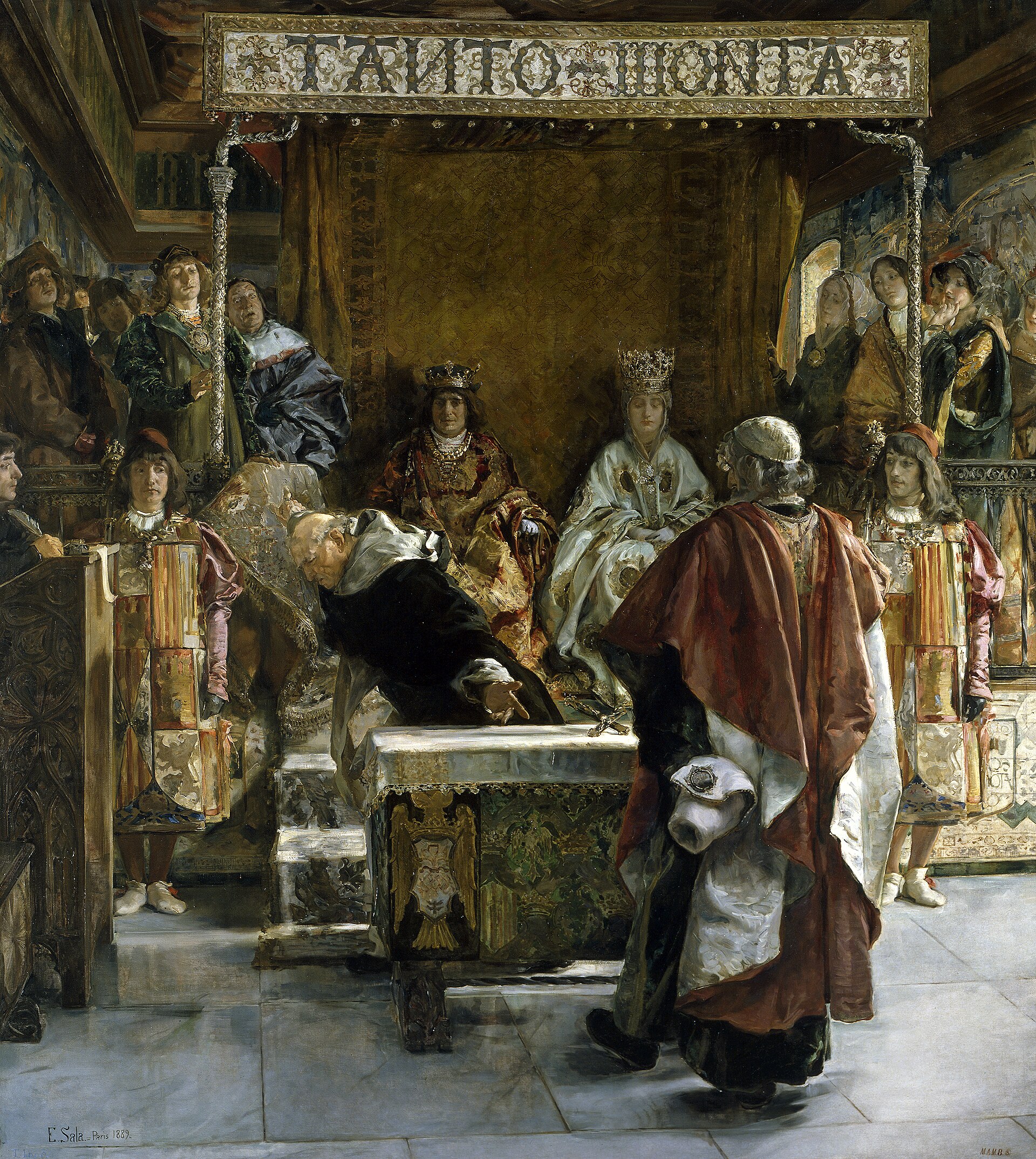
Emilio Sala, The Expulsion of the Jews: Torquemada presents the edict to the royal couple in 1492, painting from 1889
Image: Emilio Sala,
Public domain,
Source
What happened to the people
Who was affected? Victims and numbers
It was above all through Torquemada's efforts that the Jews were expelled from Spain in 1492. The edict of expulsion of 30 March gave the entire Jewish population until 31 July to be baptised or to leave the country, on pain of death, also for any attempt to return.
Evidence: The Catholic Encyclopedia, Bd. 14 (1912), Abschnitt zur Vertreibung der Juden
„Chiefly through his instrumentality the Jews were expelled from Spain in 1492“
Tomas de Torquemada, Abschnitt zur Vertreibung der Juden.
OriginalEvidence: Macmillan; Project Gutenberg (eBook 43296), Bd. 1, Buch 1, Kap. 3, „Expulsion of the Jews“
„It gave the entire Jewish population of Spain until July 31st in which to change their religion or to leave the country, under penalty of death, which was likewise threatened for any attempt to return“
Henry Charles Lea, A History of the Inquisition of Spain, Bd. 1 (New York 1906), Bd. 1, Buch 1, Kap. 3, „Expulsion of the Jews“.
Original
How were they charged and sentenced?
In 1483 the pope appointed him Grand Inquisitor of Castile, soon also of Aragon. As the pope's representative he directed the entire Inquisition in Spain, set up tribunals in Valladolid, Seville, Jaén, Ávila, Córdoba, Villa Real and Saragossa and gave them rules of procedure in 1484.
Evidence: The Catholic Encyclopedia, Bd. 14 (1912), Abschnitt zur Inquisition
„In 1483 the pope appointed Torquemada, who had been an assistant inquisitor since 11 February 1482, Grand Inquisitor of Castile, and on 17 October extended his jurisdiction over Aragon“
Tomas de Torquemada, Abschnitt zur Inquisition.
OriginalEvidence: The Catholic Encyclopedia, Bd. 14 (1912), Abschnitt zur Inquisition
„As papal representative and the highest official of the inquisitorial court, Torquemada directed the entire business of the Inquisition in Spain“
Tomas de Torquemada, Abschnitt zur Inquisition.
OriginalEvidence: The Catholic Encyclopedia, Bd. 14 (1912), Abschnitt zur Inquisition
„He convened a general assembly of Spanish inquisitors at Seville, 29 November, 1484, and presented an outline of twenty-eight articles for their guidance“
Tomas de Torquemada, Abschnitt zur Inquisition.
Original
What happened to those affected?
The expelled had to sell their belongings in the shortest possible time; they were not allowed to take gold or silver with them. Before departure, all boys and girls over twelve years of age were married. At the beginning of July the exodus began, on foot, on horseback, on donkeys and in carts.
Evidence: Macmillan; Project Gutenberg (eBook 43296), Bd. 1, Buch 1, Kap. 3
„they were permitted to sell their effects and carry the proceeds with them, except that, under a general law, the export of gold and silver was prohibited“
Henry Charles Lea, A History of the Inquisition of Spain, Bd. 1 (New York 1906), Bd. 1, Buch 1, Kap. 3.
OriginalEvidence: Macmillan; Project Gutenberg (eBook 43296), Bd. 1, Buch 1, Kap. 3
„Before starting, all the boys and girls over twelve were married. Early in July the exodus commenced“
Henry Charles Lea, A History of the Inquisition of Spain, Bd. 1 (New York 1906), Bd. 1, Buch 1, Kap. 3.
Original
Background
Course of events
Torquemada was born in Valladolid in 1420 and died in Ávila on 16 September 1498.
Evidence: The Catholic Encyclopedia, Bd. 14 (1912), Einleitung
„born at Valladolid in 1420; died at Avila, 16 September, 1498“
Why? Justification and motives (according to the sources)
Because the Inquisition had no power over unbaptised Jews, Torquemada urged the royal couple to force all Jews to be baptised or to leave Spain. When the Jews offered 30,000 ducats to be left in peace, he is said to have held up a crucifix to the king: Judas had sold Christ for 30 pieces of silver, the king wanted to sell him for 30,000 ducats.
Evidence: The Catholic Encyclopedia, Bd. 14 (1912), Abschnitt zur Vertreibung der Juden
„Torquemada urged the sovereigns to compel all the Jews either to become Christians or to leave Spain“
Tomas de Torquemada, Abschnitt zur Vertreibung der Juden.
OriginalEvidence: The Catholic Encyclopedia, Bd. 14 (1912), Abschnitt zur Vertreibung der Juden
„Judas Iscariot sold Christ for 30 pieces of silver; Your Highness is about to sell him for 30,000 ducats“
Tomas de Torquemada, Abschnitt zur Vertreibung der Juden.
Original
Who received the assets, who profited?
In Aragon King Ferdinand confiscated all Jewish property and kept back from the emergency sales of the expelled as much as they would have paid him in taxes for a year. In 1494 Torquemada had the Jewish cemetery of Ávila transferred to his monastery of Santo Tomás.
Evidence: Macmillan; Project Gutenberg (eBook 43296), Bd. 1, Buch 1, Kap. 3
„Ferdinand sequestrated all Jewish property in order to afford claimants and creditors the opportunity to prove their rights“
Henry Charles Lea, A History of the Inquisition of Spain, Bd. 1 (New York 1906), Bd. 1, Buch 1, Kap. 3.
OriginalEvidence: Macmillan; Project Gutenberg (eBook 43296), Bd. 1, Buch 1, Kap. 3
„thus realizing a full year’s revenue from the trifling sums obtained through forced sales by the unhappy exiles“
Henry Charles Lea, A History of the Inquisition of Spain, Bd. 1 (New York 1906), Bd. 1, Buch 1, Kap. 3.
OriginalEvidence: Macmillan; Project Gutenberg (eBook 43296), Bd. 1, Buch 1, Kap. 3
„Torquemada obtained a fragment of the spoil by securing, March 23, 1494, from Ferdinand and Isabella, the grant of that of Avila for his convent of Santo Tomas“
Henry Charles Lea, A History of the Inquisition of Spain, Bd. 1 (New York 1906), Bd. 1, Buch 1, Kap. 3.
Original
Reference work
The Catholic Encyclopedia, Bd. 14 (1912): Tomas de Torquemada, 1 January 1912.
Original(retrieved 11 Oct 2026)
Scholarly literature
Macmillan; Project Gutenberg (eBook 43296): Henry Charles Lea, A History of the Inquisition of Spain, Bd. 1 (New York 1906).
Original(retrieved 11 Oct 2026)
 Kirchenakte