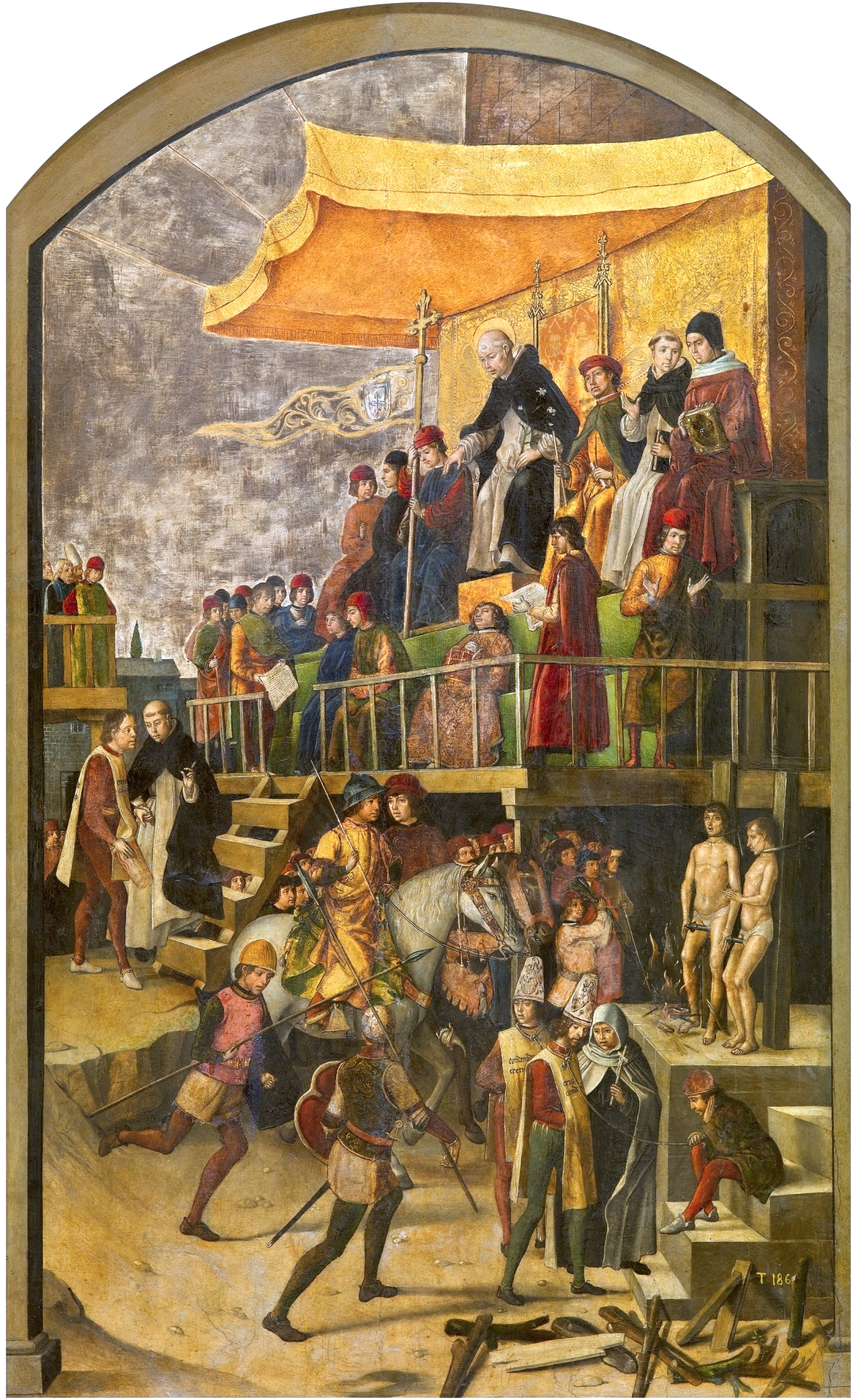
On 1 November 1478 Pope Sixtus IV authorised the Catholic Monarchs to establish the Inquisition in Spain. Under the Grand Inquisitor Torquemada about 2000 people were burned according to the Encyclopaedia Britannica; the Catholic Encyclopedia considers the number of victims incalculable. According to the Britannica it was finally abolished on 15 July 1834. In 2004 Pope John Paul II spoke of repentance for having accepted intolerance and violence in the service of truth.
Deaths
about 2,000(estimated, burned in the time of the Grand Inquisitor Torquemada alone)Evidence: Encyclopædia Britannica, 11. Auflage (1911)
„about 2000 persons were burnt in Torquemada's day“
170 years later,
on 15 June 2004: „the children of the Church cannot but return with a spirit of repentance to "the acquiescence given, especially in certain centuries, to intolerance and even the use of violence in the service of the truth"“
(Letter to Card. Roger Etchegaray on the occasion of the publication of the volume containing the Proceedings of the International Symposium on the Inquisition, Original)
Country
Spain
Institutions
Spanish Inquisition (Holy Office) Holy See Spanish Crown
Tomás de Torquemada (Grand Inquisitor) Sixtus IV (Pope) Ferdinand of Aragon (King) Isabella of Castile (Queen)
Pedro Berruguete, Saint Dominic presiding over an auto-da-fé, around 1495
Image: Pedro Berruguete,
Public domain,
Source
What happened to the people
Who was affected? Victims and numbers
According to the Encyclopaedia Britannica, about 2000 people were burned in the time of Torquemada.
Evidence: Encyclopædia Britannica, 11. Auflage (1911), Abschnitt „The Spanish Inquisition“
„about 2000 persons were burnt in Torquemada's day“
Inquisition, The, Abschnitt „The Spanish Inquisition“.
Original
The Catholic Encyclopedia considers the total number of victims not even approximately calculable.
Evidence: The Catholic Encyclopedia, Bd. 8 (1910), Abschnitt „Historical analysis“
„The number of victims cannot be calculated with even approximate accuracy“
At the first auto-da-fé on 6 February 1481 six men and women were burned; at the second a few days later three of the richest citizens of Seville. According to Lea, at least one of the victims died a good Christian.
Evidence: Macmillan; Project Gutenberg (eBook 43296), Bd. 1, Buch 1, Kap. 4, „Establishment of the Inquisition“
„the first auto de fe was celebrated February 6, 1481, when six men and women were burnt“
Henry Charles Lea, A History of the Inquisition of Spain, Bd. 1 (New York 1906), Bd. 1, Buch 1, Kap. 4, „Establishment of the Inquisition“.
OriginalEvidence: Macmillan; Project Gutenberg (eBook 43296), Bd. 1, Buch 1, Kap. 4, „Establishment of the Inquisition“
„In the second auto there were only three burnings, Diego de Susan, Manuel Sauli and Bartolomé de Torralba, three of the wealthiest and most important citizens of Seville“
Henry Charles Lea, A History of the Inquisition of Spain, Bd. 1 (New York 1906), Bd. 1, Buch 1, Kap. 4, „Establishment of the Inquisition“.
OriginalEvidence: Macmillan; Project Gutenberg (eBook 43296), Bd. 1, Buch 1, Kap. 4, „Establishment of the Inquisition“
„one at least of the victims is stated to have died as a good Christian“
Henry Charles Lea, A History of the Inquisition of Spain, Bd. 1 (New York 1906), Bd. 1, Buch 1, Kap. 4, „Establishment of the Inquisition“.
Original
Background
Course of events
On 1 November 1478 Pope Sixtus IV authorised the Catholic Monarchs to establish the Inquisition.
Evidence: The Catholic Encyclopedia, Bd. 8 (1910), Abschnitt „The Spanish Inquisition“
„On 1 November, 1478, Sixtus IV empowered the Catholic sovereigns to set up the Inquisition“
On 17 September 1480 Ferdinand and Isabella appointed the first two inquisitors for Seville.
Evidence: The Catholic Encyclopedia, Bd. 8 (1910), Abschnitt „The Spanish Inquisition“
„On 17 September, 1480, Their Catholic Majesties appointed, at first for Seville, the two Dominicans Miguel de Morillo and Juan de San Martin as inquisitors“
Inquisition, Abschnitt „The Spanish Inquisition“.
Original · Archive copyEvidence: Encyclopædia Britannica, 11. Auflage (1911), Abschnitt „The Spanish Inquisition“
„It was created in 1480 by Ferdinand and Isabella“
Inquisition, The, Abschnitt „The Spanish Inquisition“.
Original
The works give different years for its end, the Britannica 15 July 1834, the Catholic Encyclopedia the year 1820.
Evidence: Encyclopædia Britannica, 11. Auflage (1911), Abschnitt „The Spanish Inquisition“
„finally disappeared on the 15th of July 1834“
Inquisition, The, Abschnitt „The Spanish Inquisition“.
OriginalEvidence: The Catholic Encyclopedia, Bd. 8 (1910), Abschnitt „The Spanish Inquisition“
„It was definitely abolished by the Revolution of 1820“
In Seville in 1481 the inquisitors had the richest and most respected New Christians arrested and taken to the castle of Triana with its gloomy dungeons.
Evidence: Macmillan; Project Gutenberg (eBook 43296), Bd. 1, Buch 1, Kap. 4, „The First Auto de Fe“
„arrested at the bidding of the inquisitors the richest and most honorable Conversos, magistrates and dignitaries, who were confined in San Pablo and thence transferred to the castle of Triana“
Henry Charles Lea, A History of the Inquisition of Spain, Bd. 1 (New York 1906), Bd. 1, Buch 1, Kap. 4, „The First Auto de Fe“.
Original
On the Campo de Tablada in Seville a masonry burning place was built, decorated with statues of prophets, to show that the burning was done at the command of religion.
Evidence: Macmillan; Project Gutenberg (eBook 43296), Bd. 1, Buch 1, Kap. 4, „Establishment of the Inquisition“
„a quemadero , brasero , or burning-place was constructed in the Campo de Tablada, so massively that its foundations can still be traced“
Henry Charles Lea, A History of the Inquisition of Spain, Bd. 1 (New York 1906), Bd. 1, Buch 1, Kap. 4, „Establishment of the Inquisition“.
OriginalEvidence: Macmillan; Project Gutenberg (eBook 43296), Bd. 1, Buch 1, Kap. 4, „Establishment of the Inquisition“
„although technically the burning was the work of secular justice, it was performed at the command of religion“
Henry Charles Lea, A History of the Inquisition of Spain, Bd. 1 (New York 1906), Bd. 1, Buch 1, Kap. 4, „Establishment of the Inquisition“.
Original
Why? Justification and motives (according to the sources)
As its justification, the Catholic Encyclopedia names the alleged danger to the Catholic faith from Jews (Marranos) and Muslims (Moriscos) converted only in appearance.
Evidence: The Catholic Encyclopedia, Bd. 8 (1910), Abschnitt „The Spanish Inquisition“
„The Catholic faith was then endangered by pseudo-converts from Judaism (Marranos) and Mohammedanism (Moriscos)“
According to the Britannica, King Ferdinand wanted a purely Spanish and purely royal Inquisition; pope and Inquisition quarrelled over the proceeds from confiscated property.
Evidence: Encyclopædia Britannica, 11. Auflage (1911), Abschnitt „The Spanish Inquisition“
„wished to establish an inquisition which should be entirely Spanish, and entirely royal“
Inquisition, The, Abschnitt „The Spanish Inquisition“.
OriginalEvidence: Encyclopædia Britannica, 11. Auflage (1911), Abschnitt zu Rom und der Inquisition
„the unfortunate victims had to pay twice, to the pope and to the Inquisition“
Inquisition, The, Abschnitt zu Rom und der Inquisition.
Original
Who received the assets, who profited?
King Ferdinand insisted that the confiscated property of the victims should fall to the Crown; later he also obtained the fines. "Immense sums" were drawn from the victims in the early years.
Evidence: Macmillan; Project Gutenberg (eBook 43296), Bd. 1, Buch 2, Kap. 1, „Relations with the Crown“
„He had insisted that the confiscations should enure to the crown, and he subsequently obtained the pecuniary penances“
Henry Charles Lea, A History of the Inquisition of Spain, Bd. 1 (New York 1906), Bd. 1, Buch 2, Kap. 1, „Relations with the Crown“.
OriginalEvidence: Macmillan; Project Gutenberg (eBook 43296), Bd. 1, Buch 2, Kap. 1, „Relations with the Crown“
„the immense sums gathered from the victims during the early years of intense activity“
Henry Charles Lea, A History of the Inquisition of Spain, Bd. 1 (New York 1906), Bd. 1, Buch 2, Kap. 1, „Relations with the Crown“.
Original
Response of the Church
On 15 June 2004 John Paul II wrote of repentance for the intolerance and violence in the service of truth accepted in some centuries.
Evidence: Heiliger Stuhl, Titel
„International Symposium on the Inquisition (June 15, 2004)“
Letter to Card. Roger Etchegaray on the occasion of the publication of the volume containing the Proceedings of the International Symposium on the Inquisition, Titel.
Original · Archive copyEvidence: Heiliger Stuhl, Nr. 3
„the children of the Church cannot but return with a spirit of repentance to "the acquiescence given, especially in certain centuries, to intolerance and even the use of violence in the service of the truth"“
Letter to Card. Roger Etchegaray on the occasion of the publication of the volume containing the Proceedings of the International Symposium on the Inquisition, Nr. 3.
Original · Archive copy
Church document
Heiliger Stuhl: Letter to Card. Roger Etchegaray on the occasion of the publication of the volume containing the Proceedings of the International Symposium on the Inquisition, 15 June 2004.
Original · Archive copy(retrieved 11 Oct 2026)
Scholarly literature and reference works
Scholarly literature
Macmillan; Project Gutenberg (eBook 43296): Henry Charles Lea, A History of the Inquisition of Spain, Bd. 1 (New York 1906).
Original(retrieved 11 Oct 2026)
Reference work
The Catholic Encyclopedia, Bd. 8 (1910): Inquisition, 1 January 1910.
Original · Archive copy(retrieved 11 Oct 2026)
Reference work
Encyclopædia Britannica, 11. Auflage (1911): Inquisition, The, 1 January 1911.
Original(retrieved 11 Oct 2026)
 Kirchenakte