 Kirchenakte
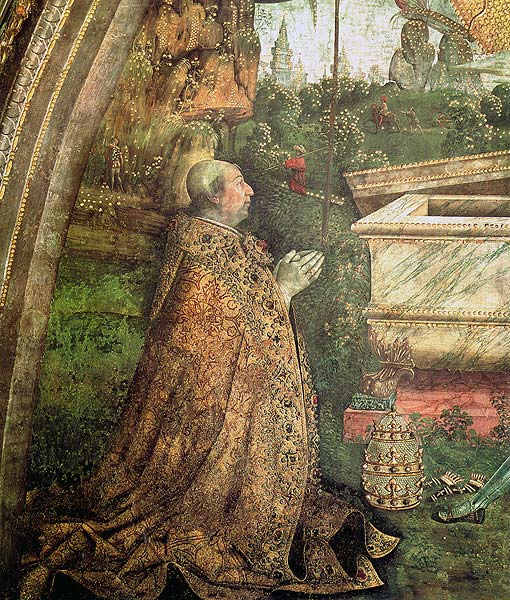
Pope Alexander VI (Rodrigo Borgia)
Through his uncle, Pope Callixtus III, Rodrigo Borgia became bishop, cardinal and vice-chancellor of the Church and one of the richest men of his time. He had four children with his mistress Vannozza. In 1492 he became pope; the Britannica (1911) considers it certain that he won the election through bribery, the Catholic Encyclopedia considers it not improbable but not provable. As pope he procured offices and lands for his children, sold spiritual and secular offices according to both sources and took in 120,000 ducats for the appointment of twelve cardinals. According to the Britannica, he had wealthy opponents accused, imprisoned and their property confiscated.
- Life dates
- 1 Jan 1431-18 Aug 1503 (72 years old)
- Country
- Italy, Spain, Vatican City
- Institutions
- Holy See
Papal States - Category
- Expropriation, Financial misconduct
- Level of evidence
- B two independent scholarly sources · what does this mean?
- Persons involved
- Vannozza Catanei (mistress, mother of his four children)
Cesare Borgia (son, cardinal at the age of 18)
Juan Borgia (son)
Giulia Farnese (mistress)
Alessandro Farnese (brother of Giulia Farnese, appointed cardinal by him)
Callixtus III (Pope, his uncle)
Virginio Orsini (died as a prisoner, his property was confiscated)

What happened to the people
Who was affected? Victims and numbers
- According to the Britannica, he began a series of expropriations: rich cardinals, nobles or officials were accused of some offence, imprisoned and sometimes murdered, and then their property was confiscated. One of the victims was his own secretary.
Evidence: Encyclopædia Britannica, 11. Auflage, Bd. 1 (1911), Wikisource, Artikel Alexander VI.
„the pope began a series of confiscations, of which one of the victims was his own secretary“
Alexander (popes), Abschnitt Alexander VI., Artikel Alexander VI.. Original Evidence: Encyclopædia Britannica, 11. Auflage, Bd. 1 (1911), Wikisource, Artikel Alexander VI.
„any cardinal, nobleman or official who was known to be rich would be accused of some offence; imprisonment and perhaps murder followed at once, and then the confiscation of his property“
Alexander (popes), Abschnitt Alexander VI., Artikel Alexander VI.. Original
How were they charged and sentenced?
- The sources contradict each other on the papal election of 1492. The Britannica writes that never had so much bribe money flowed at an election and that Borgia bought most of the votes. The Catholic Encyclopedia calls the buying of votes the general conviction and not improbable, but legally difficult to prove.
Evidence: Encyclopædia Britannica, 11. Auflage, Bd. 1 (1911), Wikisource, Artikel Alexander VI.
„at no previous or subsequent election were such immense sums of money spent on bribery, and Borgia by his great wealth succeeded in buying the largest number of votes“
Alexander (popes), Abschnitt Alexander VI., Artikel Alexander VI.. Original Evidence: The Catholic Encyclopedia, Bd. 1 (1907), Artikel Pope Alexander VI
„That he obtained the papacy through simony was the general belief“
Pope Alexander VI, Artikel Pope Alexander VI. Original · Archive copy Evidence: The Catholic Encyclopedia, Bd. 1 (1907), Artikel Pope Alexander VI
„though it would be difficult to prove it juridically“
Pope Alexander VI, Artikel Pope Alexander VI. Original · Archive copy
What happened to those affected?
- According to the Britannica, the state of Rome became more wretched every day: the city swarmed with adventurers, murderers, prostitutes and informers, murder and robbery went unpunished, heretics and Jews were admitted to the city for bribes, and the pope lived a purely worldly and immoral life.
Evidence: Encyclopædia Britannica, 11. Auflage, Bd. 1 (1911), Wikisource, Artikel Alexander VI.
„The city swarmed with Spanish adventurers, assassins, prostitutes and informers; murder and robbery were committed with impunity, heretics and Jews were admitted to the city on payment of bribes, and the pope himself shamelessly cast aside all show of decorum, living a purely secular and“
Alexander (popes), Abschnitt Alexander VI., Artikel Alexander VI.. Original
Background
Course of events
- Rodrigo Borgia was born near Valencia on 1 January 1431 and died in Rome on 18 August 1503.
Evidence: The Catholic Encyclopedia, Bd. 1 (1907), Artikel Pope Alexander VI, Beginn
„Rodrigo Borgia, born at Xativa, near Valencia, in Spain, 1 January, 1431; died in Rome, 18 August, 1503.“
Pope Alexander VI, Artikel Pope Alexander VI, Beginn. Original · Archive copy
Why? Justification and motives (according to the sources)
- According to the Britannica, his "unbridled passion" for endowing his relatives at the expense of the Church and his neighbours soon became manifest; for this he was ready to commit any crime and plunged all Italy into war. The Catholic Encyclopedia also writes that his action against the barons became more and more identified with schemes for the aggrandizement of his family; there was no place in his programme for a reform of abuses.
Evidence: Encyclopædia Britannica, 11. Auflage, Bd. 1 (1911), Wikisource, Artikel Alexander VI.
„his unbridled passion for endowing his relatives at the expense of the church and of his neighbours became manifest. For this object he was ready to commit any crime and to plunge all Italy into war.“
Alexander (popes), Abschnitt Alexander VI., Artikel Alexander VI.. Original Evidence: The Catholic Encyclopedia, Bd. 1 (1907), Artikel Pope Alexander VI
„this laudable purpose became more and more identified in his mind with schemes for the aggrandizement of his family . There was no place in his programme for a reform of abuses.“
Pope Alexander VI, Artikel Pope Alexander VI. Original · Archive copy
Who received the assets, who profited?
- After the election of his uncle Callixtus III he became successively bishop, cardinal and vice-chancellor of the Church; the Britannica calls this nepotism. He accumulated so many archbishoprics, bishoprics and abbeys that, according to the Catholic Encyclopedia, he became one of the richest men of his time.
Evidence: Encyclopædia Britannica, 11. Auflage, Bd. 1 (1911), Wikisource, Artikel Alexander VI.
„he was created successively bishop, cardinal and vice-chancellor of the church, an act of nepotism characteristic of the age“
Alexander (popes), Abschnitt Alexander VI., Artikel Alexander VI.. Original Evidence: The Catholic Encyclopedia, Bd. 1 (1907), Artikel Pope Alexander VI
„he became one of the wealthiest men of his time“
Pope Alexander VI, Artikel Pope Alexander VI. Original · Archive copy - To obtain money for his campaigns, according to the Catholic Encyclopedia, he disposed of civil and spiritual privileges and offices "in a scandalous manner"; the Britannica speaks of the sale of offices as a veritable scandal.
Evidence: The Catholic Encyclopedia, Bd. 1 (1907), Artikel Pope Alexander VI
„in order to obtain money for his military operations he disposed of civil and spiritual privileges and offices in a scandalous manner“
Pope Alexander VI, Artikel Pope Alexander VI. Original · Archive copy Evidence: Encyclopædia Britannica, 11. Auflage, Bd. 1 (1911), Wikisource, Artikel Alexander VI.
„the sale of offices became a veritable scandal“
Alexander (popes), Abschnitt Alexander VI., Artikel Alexander VI.. Original - In 1500 he appointed twelve new cardinals and received 120,000 ducats for it. In the same Holy Year, pilgrims brought money for indulgences to Rome, with which he financed the campaigns of his son Cesare.
Evidence: Encyclopædia Britannica, 11. Auflage, Bd. 1 (1911), Wikisource, Artikel Alexander VI.
„The pope, ever in need of money, now created twelve new cardinals, from whom he received 120,000 ducats“
Alexander (popes), Abschnitt Alexander VI., Artikel Alexander VI.. Original Evidence: Encyclopædia Britannica, 11. Auflage, Bd. 1 (1911), Wikisource, Artikel Alexander VI.
„bringing money for the purchase of indulgences, so that Alexander was able to furnish Cesare with funds for his enterprise“
Alexander (popes), Abschnitt Alexander VI., Artikel Alexander VI.. Original - After Virginio Orsini had died as a prisoner in Naples, the pope confiscated his property; in 1497 the Orsini family had to pay 50,000 ducats for their confiscated lands.
Evidence: Encyclopædia Britannica, 11. Auflage, Bd. 1 (1911), Wikisource, Artikel Alexander VI.
„Virginio Orsini, who had been captured by the Spaniards, died a prisoner at Naples, and the pope confiscated his property“
Alexander (popes), Abschnitt Alexander VI., Artikel Alexander VI.. Original Evidence: Encyclopædia Britannica, 11. Auflage, Bd. 1 (1911), Wikisource, Artikel Alexander VI.
„the Orsini paying 50,000 ducats in exchange for their confiscated lands“
Alexander (popes), Abschnitt Alexander VI., Artikel Alexander VI.. Original
Response of the Church
- From around 1470 he had a relationship with the Roman woman Vannozza Catanei, the mother of his four children Juan, Cesare, Lucrezia and Jofre. Pope Pius II sharply rebuked him for misconduct in Siena; according to the Catholic Encyclopedia he continued to live this way even after his ordination as a priest in 1468.
Evidence: The Catholic Encyclopedia, Bd. 1 (1907), Artikel Pope Alexander VI
„Towards 1470 began his relations with the Roman lady, Vanozza Catanei, the mother of his four children“
Pope Alexander VI, Artikel Pope Alexander VI. Original · Archive copy Evidence: The Catholic Encyclopedia, Bd. 1 (1907), Artikel Pope Alexander VI
„Even after his ordination to the priesthood, in 1468, he continued his evil ways.“
Pope Alexander VI, Artikel Pope Alexander VI. Original · Archive copy - Already in 1493 he had appointed twelve cardinals, among them his eighteen-year-old son Cesare and Alessandro Farnese, the brother of his mistress Giulia Farnese.
Evidence: Encyclopædia Britannica, 11. Auflage, Bd. 1 (1911), Wikisource, Artikel Alexander VI.
„he created twelve new cardinals, among them his own son Cesare, then only eighteen years old, and Alessandro Farnese, the brother of Giulia Bella, one of the pope’s mistresses“
Alexander (popes), Abschnitt Alexander VI., Artikel Alexander VI.. Original
See also
-
1452-2023 · 571 years
Papal bulls on conquest and enslavement and the "Doctrine of Discovery"
- Bolivia
- Portugal
- Vatican City
- Admission
- Expropriation
- Colonialism
- Slavery
-
Person 21 Sep 1452-23 May 1498 · 45 years old
Girolamo Savonarola
- Italy
- Torture
- Heresy trials
- Murder
Scholarly literature and reference works
- Reference work
The Catholic Encyclopedia, Bd. 1 (1907): Pope Alexander VI, 1 January 1907. Original · Archive copy (retrieved 12 Oct 2026) - Reference work
Encyclopædia Britannica, 11. Auflage, Bd. 1 (1911), Wikisource: Alexander (popes), Abschnitt Alexander VI., 1 January 1911. Original (retrieved 12 Oct 2026)
Change log (4)
The change log is kept in German only.
- : Aktualisiert: Englische Übersetzung
- : Aktualisiert: Tatsachen
- : Aktualisiert: Personen
- : Aufgenommen
Last changed on 22 October 2026. Is something missing or wrong? Suggest an addition or correction.