 Kirchenakte
Person 21 Sep 1452-23 May 1498 · 45 years old
· show in timeline
Girolamo Savonarola
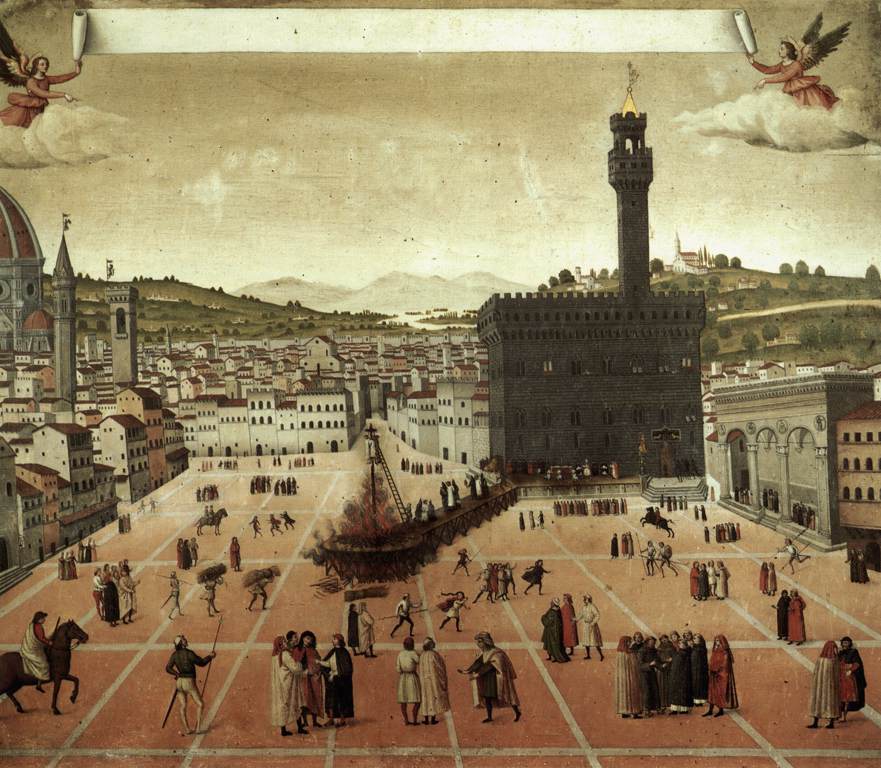
The Dominican Girolamo Savonarola preached in Florence against the way of life in Rome and was excommunicated on 12 May 1497. After his arrest the monks were tortured; on 22 May 1498 he and two fellow friars were sentenced to death, hanged on 23 May and their bodies burned.
- Life dates
- 21 Sep 1452-23 May 1498 (45 years old)
- Country
- Italy
- Institutions
- Holy See
Republic of Florence - Category
- Torture, Heresy trials, Murder
- Level of evidence
- B two independent scholarly sources · what does this mean?
- Persons involved
- Alexander VI (Pope)

What happened to the people
Who was affected? Victims and numbers
- Savonarola's fellow friars Domenico and Silvestro were executed with him. Domenico did not recant under any torture; Silvestro confessed everything he was accused of at the mere sight of the rack. Savonarola had to die last, after his disciples were already hanging on the cross.
Evidence: Encyclopædia Britannica, 11. Auflage (1911), Artikel Savonarola
„No extremity of torture could make him recant or extract a syllable to Savonarola’s hurt“
Savonarola, Girolamo, Artikel Savonarola. Original Evidence: Encyclopædia Britannica, 11. Auflage (1911), Artikel Savonarola
„Frà Silvestro on the contrary gave way at mere sight of the rack“
Savonarola, Girolamo, Artikel Savonarola. Original Evidence: Encyclopædia Britannica, 11. Auflage (1911), Artikel Savonarola
„By a refinement of cruelty Savonarola was the last to suffer. His disciples' bodies already dangled from the arms of the cross before he was hung on the centre beam.“
Savonarola, Girolamo, Artikel Savonarola. Original
How were they charged and sentenced?
- He was excommunicated on 12 May 1497.
Evidence: The Catholic Encyclopedia, Bd. 13 (1912), Lebenslauf
„On 12 May, 1497, he was excommunicated“
Girolamo Savonarola, Lebenslauf. Original - The imprisoned monks were tortured; according to the Catholic Encyclopedia the trial records were falsified by the notary.
Evidence: The Catholic Encyclopedia, Bd. 13 (1912), Lebenslauf
„proceedings, which were, however, falsified by the notary, still exist. The captured monks were tortured“
Girolamo Savonarola, Lebenslauf. Original - On 22 May 1498 he and two fellow friars were sentenced to death, hanged on 23 May and their bodies burned.
Evidence: The Catholic Encyclopedia, Bd. 13 (1912), Lebenslauf
„On 22 May, 1498, Savonarola and two other members of the order were condemned to death“
Girolamo Savonarola, Lebenslauf. Original Evidence: The Catholic Encyclopedia, Bd. 13 (1912), Lebenslauf
„They were hanged on 23 May and their bodies burned“
Girolamo Savonarola, Lebenslauf. Original
What happened to those affected?
- The judges were his bitterest enemies. Under daily torture he confessed everything demanded and retracted each time as soon as he came off the rack; because the confessions were too confused, a false report was drawn up and published. The papal commissioners tortured him even more severely on three days. On the way to the execution boys pricked the prisoners' feet with pointed sticks; the remains were thrown into the Arno.
Evidence: Encyclopædia Britannica, 11. Auflage (1911), Artikel Savonarola
„Savonarola’s judges were chosen from his bitterest foes. Day after day he was tortured“
Savonarola, Girolamo, Artikel Savonarola. Original Evidence: Encyclopædia Britannica, 11. Auflage (1911), Artikel Savonarola
„a false account of the friar’s avowals was drawn up and published“
Savonarola, Girolamo, Artikel Savonarola. Original Evidence: Encyclopædia Britannica, 11. Auflage (1911), Artikel Savonarola
„On three successive days they “examined” the prior with worse tortures than before.“
Savonarola, Girolamo, Artikel Savonarola. Original Evidence: Encyclopædia Britannica, 11. Auflage (1911), Artikel Savonarola
„wanton boys thrust sharp sticks between the planks to wound their feet“
Savonarola, Girolamo, Artikel Savonarola. Original Evidence: Encyclopædia Britannica, 11. Auflage (1911), Artikel Savonarola
„At dusk the martyrs' remains were collected in a cart and thrown into the Arno.“
Savonarola, Girolamo, Artikel Savonarola. Original
Witness accounts and records
he reasserted his innocence when unbound, crying out, “My God, I denied Thee for fear of pain.”
To the bishop’s formula, “I separate thee from the church militant and the church triumphant,” Savonarola replied in firm tones, “Not from the church triumphant; that is beyond thy power.”
Background
Course of events
- Savonarola was born in Ferrara on 21 September 1452 and died in Florence on 23 May 1498.
Evidence: The Catholic Encyclopedia, Bd. 13 (1912), Einleitung
„Born at Ferrara, 21 September, 1452; died at Florence, 23 May, 1498“
Girolamo Savonarola, Einleitung. Original Evidence: Encyclopædia Britannica, 11. Auflage (1911), Einleitung
„was born at Ferrara on the 21st of September 1452“
Savonarola, Girolamo, Einleitung. Original
Why? Justification and motives (according to the sources)
- The pope had seen a transcript of Savonarola's denunciations of his crimes and resolved to silence him. According to the Britannica, the papal commissioners who conducted the second trial had the pope's orders that Savonarola was to die "even were he a second John the Baptist".
Evidence: Encyclopædia Britannica, 11. Auflage (1911), Artikel Savonarola
„having seen a transcript of one of Savonarola’s denunciations of his crimes, resolved to silence this daring preacher“
Savonarola, Girolamo, Artikel Savonarola. Original Evidence: Encyclopædia Britannica, 11. Auflage (1911), Artikel Savonarola
„They had the pope’s orders that Savonarola was to die “even were he a second John the Baptist.”“
Savonarola, Girolamo, Artikel Savonarola. Original
Who received the assets, who profited?
- When Savonarola denounced the crimes of Pope Alexander VI, according to the Britannica the pope first tried bribery and offered him a cardinal's hat. Savonarola refused from the pulpit: he wanted no hat but that of a martyr, red with his own blood.
Evidence: Encyclopædia Britannica, 11. Auflage (1911), Artikel Savonarola, Abschnitt Conflict with the Pope
„Bribery was the first weapon employed, and a cardinal’s“
Savonarola, Girolamo, Artikel Savonarola, Abschnitt Conflict with the Pope. Original Evidence: Encyclopædia Britannica, 11. Auflage (1911), Artikel Savonarola, Abschnitt Conflict with the Pope
„hat was held out as a bait. But Savonarola indignantly spurned the offer, replying to it from the pulpit with the prophetic words: “No hat will I have but that of a martyr, reddened with my own blood.”“
Savonarola, Girolamo, Artikel Savonarola, Abschnitt Conflict with the Pope. Original
See also
-
Person 1 Jan 1431-18 Aug 1503 · 72 years old
Pope Alexander VI (Rodrigo Borgia)
- Italy
- Spain
- Vatican City
- Expropriation
- Financial misconduct
Scholarly literature and reference works
- Reference work
The Catholic Encyclopedia, Bd. 13 (1912): Girolamo Savonarola, 1 January 1912. Original (retrieved 11 Oct 2026) - Reference work
Encyclopædia Britannica, 11. Auflage (1911): Savonarola, Girolamo, 1 January 1911. Original (retrieved 11 Oct 2026)
Change log (5)
The change log is kept in German only.
- : Aktualisiert: Englische Übersetzung
- : Aktualisiert: Zeitzeugen und Originaltexte, Tatsachen
- : Aktualisiert: Tatsachen
- : Aktualisiert: Tatsachen
- : Aktualisiert: Tatsachen
Last changed on 22 October 2026. Is something missing or wrong? Suggest an addition or correction.