 Kirchenakte
Reich Concordat of 1933 between the Holy See and the German Reich
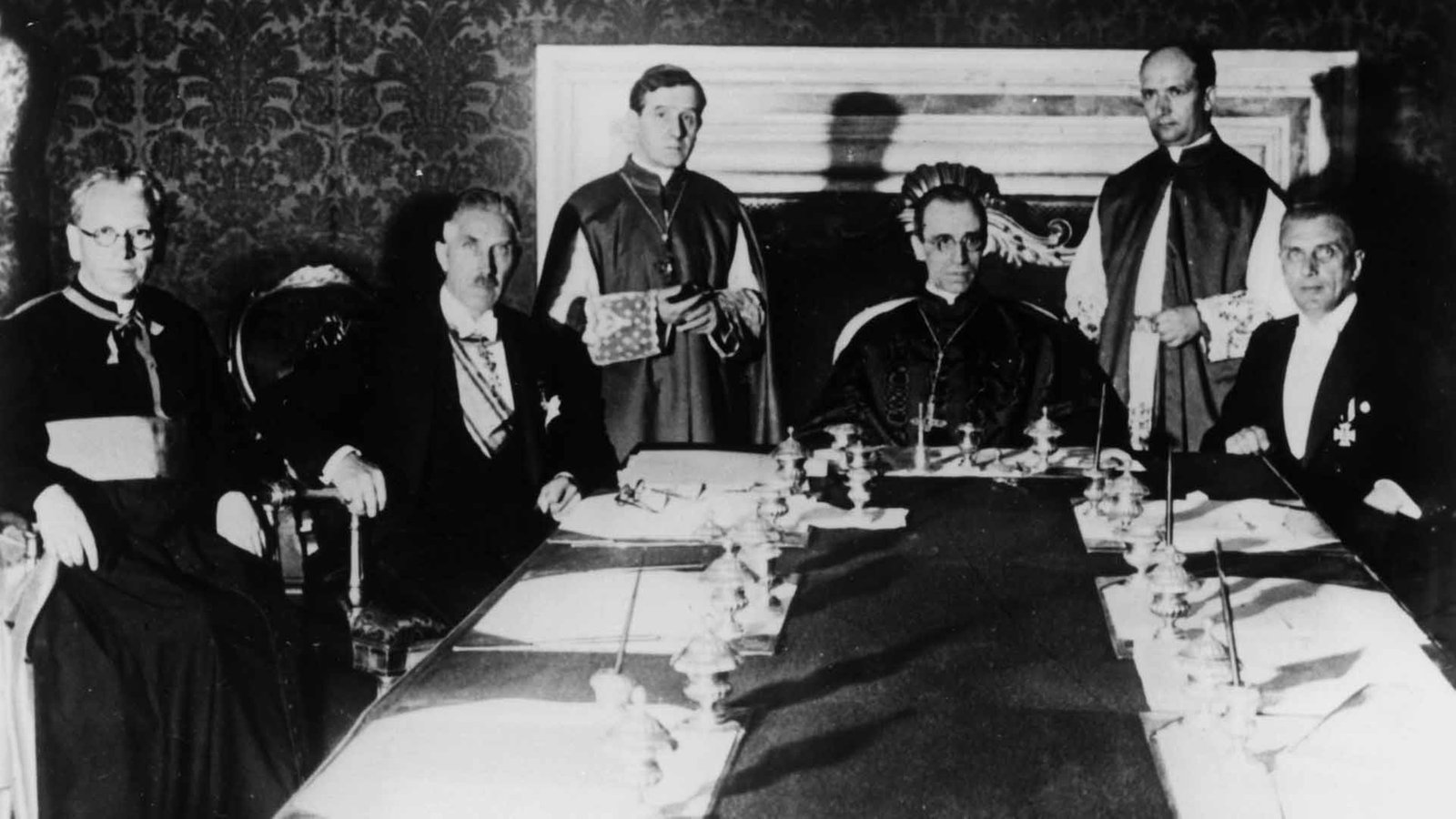
On 20 July 1933 Cardinal Secretary of State Eugenio Pacelli, the later Pope Pius XII, and Vice-Chancellor Franz von Papen signed the concordat between the Holy See and the German Reich in the Vatican; it has been in force since 10 September 1933. The Reich government had offered the negotiations in the summer of 1933. Bishops henceforth had to swear an oath of loyalty to the Reich and promise to respect the government and to have it respected by their clergy. Clerics were forbidden any party-political activity. In return the Reich guaranteed, among other things, religious instruction, denominational schools and church property.
- Period
- 20 Jul 1933 (1 day)
- Country
- Germany, Vatican City
- Institutions
- Holy See
German Reich - Category
- Agreements with dictatorships
- Level of evidence
- A Primary source · what does this mean?
- Persons
- Eugenio Pacelli (Pius XII) (Cardinal Secretary of State, plenipotentiary and signatory for the Holy See)
Franz von Papen (Vice-Chancellor, plenipotentiary of the German Reich)

Background
Course of events
- In 1937 Pope Pius XI wrote that the Reich government had proposed the concordat negotiations to him in the summer of 1933; he had taken them up and had them concluded with a solemn agreement.
Evidence: Heiliger Stuhl (vatican.va), Enzyklika Mit brennender Sorge, Nr. 3
„im Sommer 1933 die Uns von der Reichsregierung in Anknüpfung an einen jahrealten früheren Entwurf angetragenen Konkordatsverhandlungen aufnahmen“
Pius XI., Enzyklika „Mit brennender Sorge“, 14. März 1937, Enzyklika Mit brennender Sorge, Nr. 3. Original · Archive copy - The plenipotentiaries were Cardinal Eugenio Pacelli as the pope's Secretary of State and Vice-Chancellor Franz von Papen. It was signed in Vatican City on 20 July 1933; with the exchange of the instruments of ratification on 10 September 1933 the concordat entered into force.
Evidence: Heiliger Stuhl, Staatssekretariat (vatican.va), Einleitung
„Kardinal Eugen Pacelli, Ihren Staatssekretär, und der Deutsche Reichspräsident zum Bevollmächtigten den Vizekanzler des Deutschen Reiches, Herrn FRANZ VON PAPEN“
Konkordat zwischen dem Heiligen Stuhl und dem Deutschen Reich vom 20. Juli 1933 (AAS XXV, 1933, S. 390–413), Einleitung. Original · Archive copy Evidence: Heiliger Stuhl, Staatssekretariat (vatican.va), Schlussprotokoll
„In der Vatikanstadt, am 20. Juli 1933. EUGENIO KARDINAL PACELLI FRANZ VON PAPEN“
Konkordat zwischen dem Heiligen Stuhl und dem Deutschen Reich vom 20. Juli 1933 (AAS XXV, 1933, S. 390–413), Schlussprotokoll. Original · Archive copy Evidence: Heiliger Stuhl, Staatssekretariat (vatican.va), Ratifikationsvermerk
„a die 10 Septembris 1933“
Konkordat zwischen dem Heiligen Stuhl und dem Deutschen Reich vom 20. Juli 1933 (AAS XXV, 1933, S. 390–413), Ratifikationsvermerk. Original · Archive copy
Who received the assets, who profited?
- The Reich guaranteed Catholic religious instruction as a regular school subject, the retention and establishment of Catholic denominational schools and pastoral care for the Reichswehr. In religious instruction, education in patriotic sense of duty was to be cultivated "with particular emphasis".
Evidence: Heiliger Stuhl, Staatssekretariat (vatican.va), Artikel 21
„Im Religionsunterricht wird die Erziehung zu vaterländischem, staatsbürgerlichem und sozialem Pflichtbewusstsein aus dem Geiste des christlichen Glaubens- und Sittengesetzes mit besonderem Nachdruck gepflegt werden“
Konkordat zwischen dem Heiligen Stuhl und dem Deutschen Reich vom 20. Juli 1933 (AAS XXV, 1933, S. 390–413), Artikel 21. Original · Archive copy Evidence: Heiliger Stuhl, Staatssekretariat (vatican.va), Artikel 23
„Die Beibehaltung und Neueinrichtung katholischer Bekenntnisschulen bleibt gewährleistet.“
Konkordat zwischen dem Heiligen Stuhl und dem Deutschen Reich vom 20. Juli 1933 (AAS XXV, 1933, S. 390–413), Artikel 23. Original · Archive copy Evidence: Heiliger Stuhl, Staatssekretariat (vatican.va), Artikel 27
„Der Deutschen Reichswehr wird für die zu ihr gehörenden katholischen Offiziere, Beamten und Mannschaften, sowie deren Familien, eine exemte Seelsorge zugestanden.“
Konkordat zwischen dem Heiligen Stuhl und dem Deutschen Reich vom 20. Juli 1933 (AAS XXV, 1933, S. 390–413), Artikel 27. Original · Archive copy
Response of the Church
- Before taking office, bishops must swear an oath of loyalty before the Reich Governor or the Reich President: loyalty to the German Reich, respect for the government, also by their clergy, and the endeavour to avert any harm from the State.
Evidence: Heiliger Stuhl, Staatssekretariat (vatican.va), Artikel 16
„Ich schwöre und verspreche, die verfassungsmässig gebildete Regierung zu achten und von meinem Klerus achten zu lassen.“
Konkordat zwischen dem Heiligen Stuhl und dem Deutschen Reich vom 20. Juli 1933 (AAS XXV, 1933, S. 390–413), Artikel 16. Original · Archive copy Evidence: Heiliger Stuhl, Staatssekretariat (vatican.va), Artikel 16
„werde ich in Ausübung des mir übertragenen geistlichen Amtes jeden Schaden zu verhüten trachten, der es bedrohen könnte“
Konkordat zwischen dem Heiligen Stuhl und dem Deutschen Reich vom 20. Juli 1933 (AAS XXV, 1933, S. 390–413), Artikel 16. Original · Archive copy - Before a bishop is appointed, his name is communicated to the Reich Governor and it is established that there are no objections of a general political nature against him.
Evidence: Heiliger Stuhl, Staatssekretariat (vatican.va), Artikel 14
„dem Reichsstatthalter in dem zuständigen Lande mitgeteilt und festgestellt ist, dass gegen ihn Bedenken allgemein politischer Natur nicht bestehen“
Konkordat zwischen dem Heiligen Stuhl und dem Deutschen Reich vom 20. Juli 1933 (AAS XXV, 1933, S. 390–413), Artikel 14. Original · Archive copy - The Holy See undertook to forbid clerics and members of religious orders to be members of political parties or to work for them.
Evidence: Heiliger Stuhl, Staatssekretariat (vatican.va), Artikel 32
„erlässt der Heilige Stuhl Bestimmungen, die für die Geistlichen und Ordensleute die Mitgliedschaft in politischen Parteien und die Tätigkeit für solche Parteien ausschliessen“
Konkordat zwischen dem Heiligen Stuhl und dem Deutschen Reich vom 20. Juli 1933 (AAS XXV, 1933, S. 390–413), Artikel 32. Original · Archive copy
Original documents to read
- Church document
Heiliger Stuhl, Staatssekretariat (vatican.va): Konkordat zwischen dem Heiligen Stuhl und dem Deutschen Reich vom 20. Juli 1933 (AAS XXV, 1933, S. 390–413), 20 July 1933. Original · Archive copy (retrieved 12 Oct 2026) - Church document
Heiliger Stuhl (vatican.va): Pius XI., Enzyklika „Mit brennender Sorge“, 14. März 1937, 14 March 1937. Original · Archive copy (retrieved 12 Oct 2026)
Change log (3)
The change log is kept in German only.
- : Aktualisiert: Englische Übersetzung
- : Aktualisiert: Personen
- : Aufgenommen
Last changed on 22 October 2026. Is something missing or wrong? Suggest an addition or correction.