 Kirchenakte
Sale of indulgences, forgiveness of sins for money
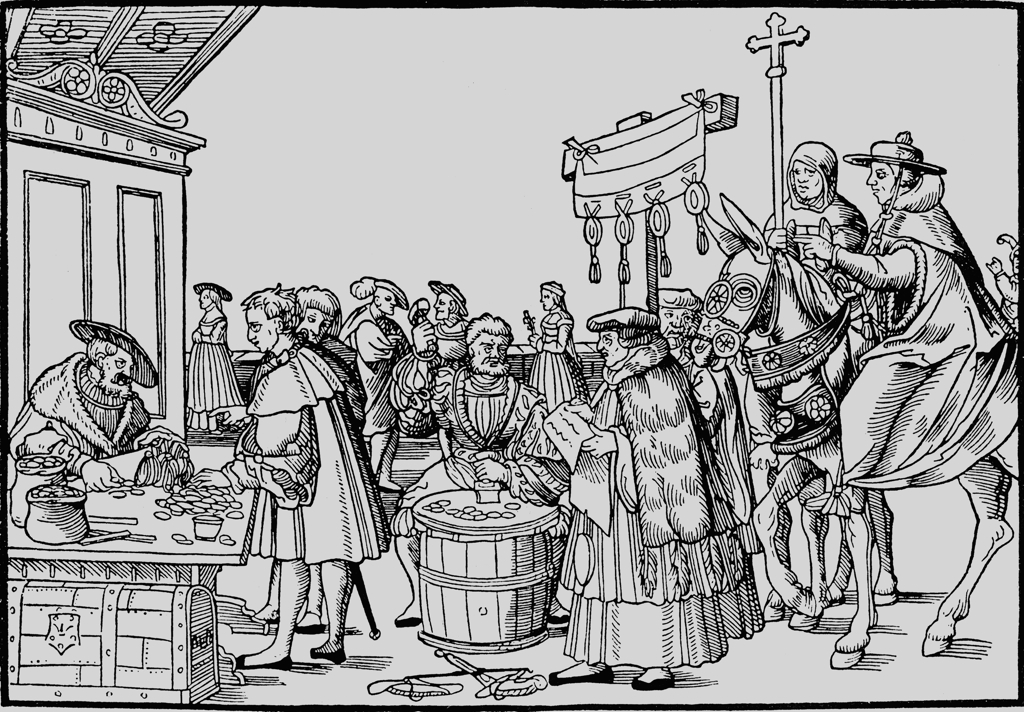
Indulgences were meant to remit the punishment due for sins; for centuries they were sold for money. As early as around 1270 the preacher Berthold of Regensburg warned that thousands believed they could buy themselves free of all their sins for a penny. In 1517 the Dominican Johann Tetzel sold indulgences for Archbishop Albrecht of Mainz: half of the proceeds went to Albrecht, who used it to pay off debts to the Fugger banking house, the other half to Pope Leo X for the building of St Peter's. Tetzel proclaimed that as soon as the coin rang in the box, the soul was freed from purgatory. Only in 1562 did the Council of Trent abolish the office of the indulgence seller.
- Period
- 1300-1562 (262 years)
- Country
- Germany, Vatican City, United Kingdom
- Institutions
- Holy See
Archbishop Albrecht of Mainz
Indulgence preachers ("pardoners")
Fugger banking house - Category
- Financial misconduct
- Level of evidence
- B two independent scholarly sources · what does this mean?
- Persons
- Johann Tetzel (Dominican, indulgence preacher)
Leo X (Pope)
Albrecht of Mainz (Archbishop of Mainz, Tetzel's principal)
Boniface VIII (Pope, introduced the jubilee indulgence)

What happened to the people
Who was affected? Victims and numbers
- Those affected were the faithful, who were promised forgiveness of sins for money. As early as 1390 Pope Boniface IX complained that indulgence sellers absolved even impenitent sinners for ridiculously small sums.
Evidence: Encyclopædia Britannica, 11. Auflage (1911), Abschnitt zu den Missbräuchen
„Pope Boniface IX., complained of their absolving even impenitent sinners for ridiculously small sums“
Indulgence, Abschnitt zu den Missbräuchen. Original
What happened to those affected?
- In 1450 the Chancellor of the University of Oxford, Thomas Gascoigne, wrote that sinners said they did not care how much they sinned because they could buy forgiveness from the pope for four or six pence or a game of tennis.
Evidence: Encyclopædia Britannica, 11. Auflage (1911), Abschnitt zu den Missbräuchen
„whose writing and grant I have bought for 4d. or 6d. or for a game of tennis“
Indulgence, Abschnitt zu den Missbräuchen. Original
Witness accounts and records
“Fie, penny-preacher! … thou dost promise so much remission of sins for a mere halfpenny or penny, that thousands now trust thereto, and fondly dream to have atoned for all their sins with the halfpenny or penny, and thus go to hell”
Background
Course of events
- Pope Boniface VIII introduced the great jubilee indulgence in 1300; it was at first to be celebrated every hundred years, from 1475 every 25 years.
Evidence: Encyclopædia Britannica, 11. Auflage (1911), Abschnitt „Jubilee“
„This was instituted in 1300 by Boniface VIII., who pleaded a popular tradition for its celebration every hundredth year“
Indulgence, Abschnitt „Jubilee“. Original Evidence: Encyclopædia Britannica, 11. Auflage (1911), Abschnitt „Jubilee“
„again in 1475 to 25 years“
Indulgence, Abschnitt „Jubilee“. Original - Johann Tetzel, Dominican and inquisitor, appeared as an indulgence preacher from 1503; in 1516 he preached the indulgence for the building of St Peter's in Rome.
Evidence: The Catholic Encyclopedia, Bd. 14 (1912), Lebenslauf
„In 1503 he made his first appearance as a preacher of indulgences“
Johann Tetzel, Lebenslauf. Original Evidence: The Catholic Encyclopedia, Bd. 14 (1912), Lebenslauf
„his appearance as an indulgence preacher in 1516, to aid the construction of St. Peter's at Rome“
Johann Tetzel, Lebenslauf. Original
Why? Justification and motives (according to the sources)
- According to the Britannica, Tetzel promised: as soon as the coin rings in the box, the soul is freed from purgatory.
Evidence: Encyclopædia Britannica, 11. Auflage (1911), Lebenslauf, 1517
„as soon as the coin clinks in the chest, he cried, the soul is freed from purgatory“
Tetzel, Johann, Lebenslauf, 1517. Original
Who received the assets, who profited?
- The business behind Tetzel's sermons: Albrecht, who had become Archbishop of Mainz at the age of 24, had to pay Rome a high fee for his office. He agreed with Pope Leo X to pay it in cash and to recoup himself by selling indulgences. Half of the proceeds went to Albrecht, the other half to the pope for the building of St Peter's. Tetzel was accompanied by an employee of the Fuggers, from whom Albrecht had borrowed the money.
Evidence: Encyclopædia Britannica, 11. Auflage (1911), Lebenslauf, 1517
„Albrecht had been elected at the age of twenty-four to a see already impoverished by frequent successions and payments of annates to Rome“
Tetzel, Johann, Lebenslauf, 1517. Original Evidence: Encyclopædia Britannica, 11. Auflage (1911), Lebenslauf, 1517
„He had agreed with Pope Leo X. to pay his first-fruits in cash, on condition that he were allowed to recoup himself by the sale of indulgences. Half the proceeds in his province were to go to him, half to Leo X. for building the basilica of St Peter’s at Rome“
Tetzel, Johann, Lebenslauf, 1517. Original Evidence: Encyclopædia Britannica, 11. Auflage (1911), Lebenslauf, 1517
„was accompanied by a clerk of the Fuggers from whom Albrecht had borrowed the money to pay his first-fruits“
Tetzel, Johann, Lebenslauf, 1517. Original - The Elector of Brandenburg, Albrecht's brother, also promoted Tetzel in the hope of sharing in the spoils.
Evidence: Encyclopædia Britannica, 11. Auflage (1911), Lebenslauf, 1517
„the elector Joachim of Brandenburg, encouraged him at Berlin in the hope of sharing the spoils“
Tetzel, Johann, Lebenslauf, 1517. Original
Response of the Church
- In 1562 the Council of Trent abolished the office of the indulgence seller.
Evidence: Encyclopædia Britannica, 11. Auflage (1911), Abschnitt zu den Missbräuchen
„In 1562 the Council of Trent abolished the office of “pardoner.”“
Indulgence, Abschnitt zu den Missbräuchen. Original
See also
-
Person 10 Nov 1483-18 Feb 1546 · 62 years old
Martin Luther
- Germany
- Anti-Judaism
- Heresy trials
Scholarly literature and reference works
- Reference work
Encyclopædia Britannica, 11. Auflage (1911): Tetzel, Johann, 1 January 1911. Original (retrieved 11 Oct 2026) - Reference work
Encyclopædia Britannica, 11. Auflage (1911): Indulgence, 1 January 1911. Original (retrieved 11 Oct 2026) - Reference work
The Catholic Encyclopedia, Bd. 14 (1912): Johann Tetzel, 1 January 1912. Original (retrieved 11 Oct 2026)
Change log (4)
The change log is kept in German only.
- : Aktualisiert: Englische Übersetzung
- : Aktualisiert: Personen
- : Aktualisiert: Tatsachen
- : Aufgenommen
Last changed on 22 October 2026. Is something missing or wrong? Suggest an addition or correction.