 Kirchenakte
Galileo Galilei
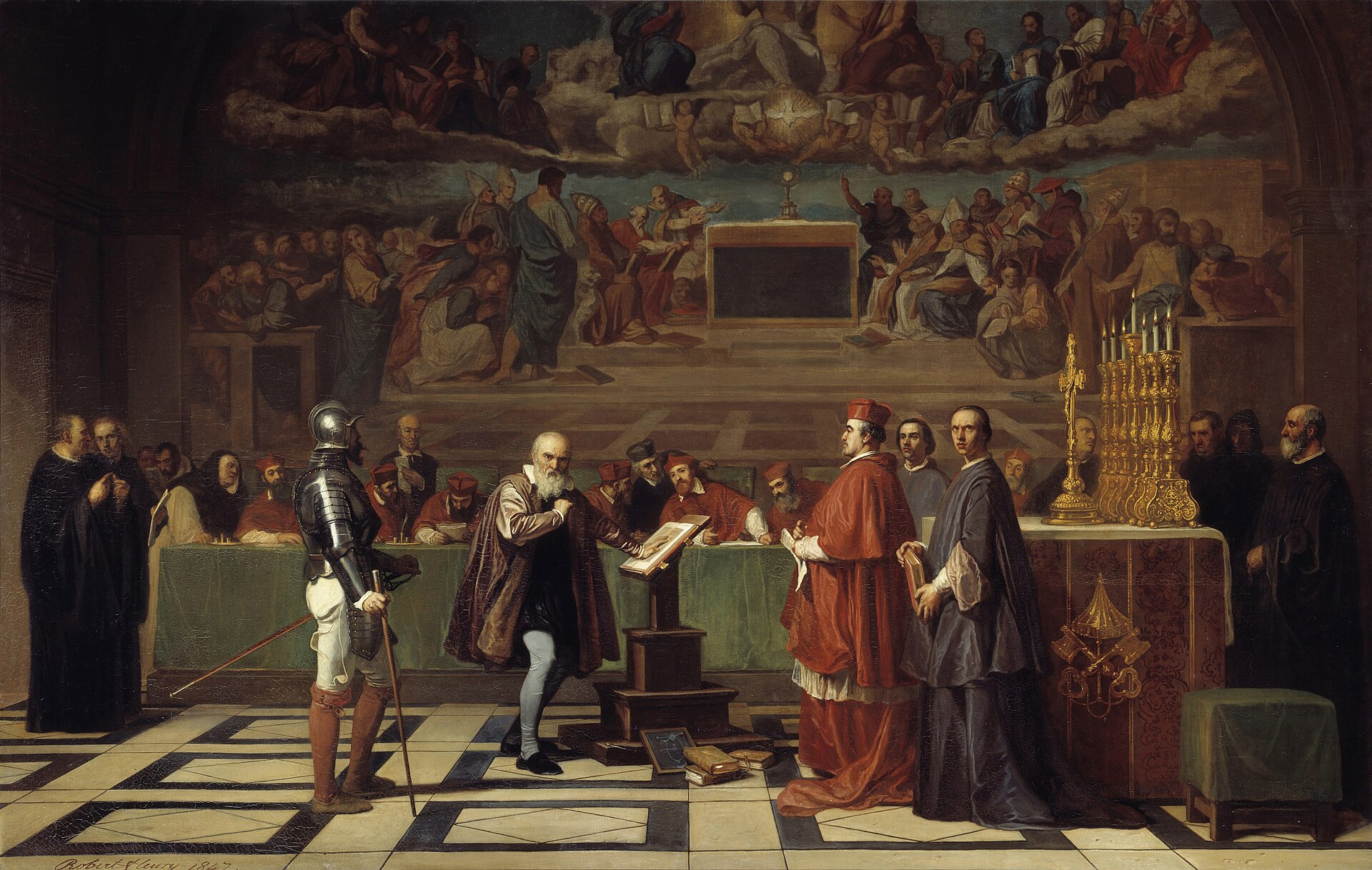
In 1616 the theologians of the Holy Office declared the doctrine of the stationary sun formally heretical; Cardinal Bellarmine forbade Galileo to hold it. After his Dialogue of 1632, the almost 70-year-old was brought before the Inquisition, interrogated under threat of torture on 21 June 1633 and on 22 June condemned as "vehemently suspected of heresy". He had to abjure in Santa Maria sopra Minerva, his book was banned, he was sentenced to imprisonment at the tribunal's discretion and remained under this sentence until his death in 1642, in the end blind and in strict seclusion in Arcetri. Only in 1992 did Pope John Paul II speak of errors by the theologians.
- Life dates
- 15 Feb 1564-8 Jan 1642 (77 years old)
- Country
- Italy
- Institutions
- Roman Inquisition (Holy Office)
Congregation of the Index - Category
- Admission, Heresy trials, Censorship
- Level of evidence
- A Primary source · what does this mean?
- Persons involved
- John Paul II (Pope)
Robert Bellarmine (Cardinal)

What happened to the people
Who was affected? Victims and numbers
- Galileo, then 70 years old, had to swear before the cardinals of the Inquisition, kneeling and with his hand on the Gospel, to curse the doctrine of the motion of the earth. He also had to undertake to denounce to the Holy Office any heretic or person suspected of heresy whom he knew.
Evidence: Römische Inquisition (Heiliges Offizium); Wikisource (italienisch), Abiura, Rom, 22. Juni 1633
„dell'età mia d'anni 70, constituto personalmente in giudizio, et inginocchiato avanti di voi“
Abiura di Galileo Galilei, Roma, 22 giugno 1633 (Le Opere di Galileo Galilei, Edizione Nazionale, Bd. XIX), Abiura, Rom, 22. Juni 1633. Original Evidence: Römische Inquisition (Heiliges Offizium); Wikisource (italienisch), Abiura, Rom, 22. Juni 1633
„con cuor sincero e fede non finta abiuro, maledico e detesto li sudetti errori et heresie“
Abiura di Galileo Galilei, Roma, 22 giugno 1633 (Le Opere di Galileo Galilei, Edizione Nazionale, Bd. XIX), Abiura, Rom, 22. Juni 1633. Original Evidence: Römische Inquisition (Heiliges Offizium); Wikisource (italienisch), Abiura, Rom, 22. Juni 1633
„ma se conoscerò alcun heretico o che sia sospetto d’heresia, lo denontiarò a questo S. Offitio“
Abiura di Galileo Galilei, Roma, 22 giugno 1633 (Le Opere di Galileo Galilei, Edizione Nazionale, Bd. XIX), Abiura, Rom, 22. Juni 1633. Original
How were they charged and sentenced?
- His Dialogue appeared in 1632, after which he was summoned before the Inquisition again. The second trial took place in 1633.
Evidence: The Catholic Encyclopedia, Bd. 6 (1909), Abschnitt zum Dialog
„This was published in 1632“
Galileo Galilei, Abschnitt zum Dialog. Original · Archive copy Evidence: The Catholic Encyclopedia, Bd. 6 (1909), Abschnitt zum Dialog
„He was therefore again cited before the Inquisition“
Galileo Galilei, Abschnitt zum Dialog. Original · Archive copy Evidence: The Catholic Encyclopedia, Bd. 6 (1909), Abschnitt zur Bewertung
„As to the second trial in 1633“
Galileo Galilei, Abschnitt zur Bewertung. Original · Archive copy - On 21 June 1633 he was interrogated under threat of torture. According to the Britannica, the threat was not carried out and, according to the records, was not intended to be.
Evidence: Encyclopædia Britannica, 11. Auflage (1911), Abschnitt 1633
„On the 21st of June he was finally examined under menace of torture“
Galileo Galilei, Abschnitt 1633. Original Evidence: Encyclopædia Britannica, 11. Auflage (1911), Abschnitt 1633
„not only that the threat of torture was not carried into execution, but that it was never intended that it should be“
Galileo Galilei, Abschnitt 1633. Original - On 22 June 1633 he had to abjure in the church of Santa Maria sopra Minerva and received his sentence. He was then 70 years old.
Evidence: Encyclopædia Britannica, 11. Auflage (1911), Abschnitt 1633
„On the 22nd of June, in the church of Santa Maria sopra Minerva, Galileo read his recantation, and received his sentence“
Galileo Galilei, Abschnitt 1633. Original Evidence: Römische Inquisition (Heiliges Offizium); Wikisource (italienisch), Urteil, Einleitung
„Fiorentino, dell’età tua d’anni 70“
Sentenza ed abiura, Roma, 22 giugno 1633 (zeitgenössische Abschrift, Staatsarchiv Modena; Le Opere di Galileo Galilei, Edizione Nazionale, Bd. XIX), Urteil, Einleitung. Original - The sentence declared him vehemently suspected of heresy, banned his book, sentenced him to imprisonment at the tribunal's discretion and to three years of weekly penitential psalms. Seven cardinals signed; the usual confirmation by the pope was missing.
Evidence: Römische Inquisition (Heiliges Offizium); Wikisource (italienisch), Urteil, Spruch
„vehementemente sospetto d’heresia, cioè d’haver tenuto e creduto dottrina falsa e contraria alle Sacre e divine Scritture“
Sentenza ed abiura, Roma, 22 giugno 1633 (zeitgenössische Abschrift, Staatsarchiv Modena; Le Opere di Galileo Galilei, Edizione Nazionale, Bd. XIX), Urteil, Spruch. Original Evidence: Römische Inquisition (Heiliges Offizium); Wikisource (italienisch), Urteil, Spruch
„ordiniamo che per publico editto sia prohibito il libro de’ Dialoghi di Galileo Galilei“
Sentenza ed abiura, Roma, 22 giugno 1633 (zeitgenössische Abschrift, Staatsarchiv Modena; Le Opere di Galileo Galilei, Edizione Nazionale, Bd. XIX), Urteil, Spruch. Original Evidence: Römische Inquisition (Heiliges Offizium); Wikisource (italienisch), Urteil, Spruch
„Ti condaniamo al carcere formale“
Sentenza ed abiura, Roma, 22 giugno 1633 (zeitgenössische Abschrift, Staatsarchiv Modena; Le Opere di Galileo Galilei, Edizione Nazionale, Bd. XIX), Urteil, Spruch. Original Evidence: Encyclopædia Britannica, 11. Auflage (1911), Abschnitt 1633
„This sentence was signed by seven cardinals, but did not receive the customary papal ratification“
Galileo Galilei, Abschnitt 1633. Original
What happened to those affected?
- He remained under the sentence of imprisonment until his death in 1642. The Catholic Encyclopedia stresses that he spent only 22 days in buildings of the Inquisition; afterwards he lived with friends and finally in strict seclusion in his villa in Arcetri.
Evidence: The Catholic Encyclopedia, Bd. 6 (1909), Abschnitt 1633
„Under the sentence of imprisonment Galileo remained till his death in 1642“
Galileo Galilei, Abschnitt 1633. Original · Archive copy Evidence: The Catholic Encyclopedia, Bd. 6 (1909), Abschnitt 1633
„Galileo spent altogether twenty-two days in the buildings of the Holy Office“
Galileo Galilei, Abschnitt 1633. Original · Archive copy Evidence: Encyclopædia Britannica, 11. Auflage (1911), Abschnitt nach dem Prozess
„the remaining eight years of his life were spent in his villa at Arcetri called “Il Giojello,” in the strict seclusion which was the prescribed condition of his comparative freedom“
Galileo Galilei, Abschnitt nach dem Prozess. Original - From 1637/38 he was completely blind.
Evidence: Encyclopædia Britannica, 11. Auflage (1911), Abschnitt nach dem Prozess
„his eyes were for ever closed in hopeless blindness“
Galileo Galilei, Abschnitt nach dem Prozess. Original
Witness accounts and records
Io Galileo Galilei sodetto ho abiurato, giurato, promesso e mi sono obligato come sopra; et in fede del vero, di mia propria mano ho sottoscritta la presente cedola di mia abiuratione et recitatala di parola in parola, in Roma, nel convento della Minerva, questo dì 22 giugno 1633.
Translation (unofficial)
I, the said Galileo Galilei, have abjured, sworn, promised and bound myself as above; and in witness of the truth I have signed with my own hand this document of my abjuration and recited it word for word, in Rome, in the convent of the Minerva, this 22nd day of June 1633.
Background
Course of events
- Galileo was born in Pisa on 15 February 1564 and died on 8 January 1642.
Evidence: The Catholic Encyclopedia, Bd. 6 (1909), Einleitung
„Born at Pisa, 15 February, 1564; died 8 January, 1642“
Galileo Galilei, Einleitung. Original · Archive copy - On 24 February 1616 the theologians of the Holy Office declared the doctrine that the sun stands motionless at the centre of the world absurd and formally heretical.
Evidence: Encyclopædia Britannica, 11. Auflage (1911), Abschnitt 1616
„On the 24th of February 1616 the consulting theologians of the Holy Office characterized the two propositions“
Galileo Galilei, Abschnitt 1616. Original Evidence: Römische Inquisition (Heiliges Offizium); Wikisource (italienisch), Urteil, Vorgeschichte
„Che il Sole sia centro del mondo et imobile di moto locale, è propositione assurda e falsa in filosofia, e formalmente heretica“
Sentenza ed abiura, Roma, 22 giugno 1633 (zeitgenössische Abschrift, Staatsarchiv Modena; Le Opere di Galileo Galilei, Edizione Nazionale, Bd. XIX), Urteil, Vorgeschichte. Original - Cardinal Bellarmine officially admonished him no longer to hold, teach or defend the condemned doctrine; on 5 March 1616 the Congregation of the Index banned Copernican writings.
Evidence: Encyclopædia Britannica, 11. Auflage (1911), Abschnitt 1616
„officially admonished not thenceforward to “hold, teach or defend” the condemned doctrine“
Galileo Galilei, Abschnitt 1616. Original Evidence: The Catholic Encyclopedia, Bd. 6 (1909), Abschnitt 1616
„a decree of the Congregation of the Index dated 5 March 1616, prohibiting various heretical works to which were added any advocating the Copernican system“
Galileo Galilei, Abschnitt 1616. Original · Archive copy
Why? Justification and motives (according to the sources)
- According to the Catholic Encyclopedia, the main reason was concern for the authority of Holy Scripture, which at that time was also regarded as the highest authority in questions of science.
Evidence: The Catholic Encyclopedia, Bd. 6 (1909), Abschnitt zur Bewertung
„what, more than all, raised alarm was anxiety for the credit of Holy Scripture“
Galileo Galilei, Abschnitt zur Bewertung. Original · Archive copy
Response of the Church
- On 3 July 1981 John Paul II set up a study commission on the Galileo case.
Evidence: Heiliger Stuhl, Nr. 4
„Une commission d'étude a été constituée dans ce but le 3 juillet 1981“
Discours du Pape Jean-Paul II aux participants à la session plénière de l'Académie pontificale des sciences, Nr. 4. Original · Archive copy
Original texts
ti sei reso a questo S. o Off. o vehementemente sospetto d’heresia, cioè d’haver tenuto e creduto dottrina falsa e contraria alle Sacre e divine Scritture
Translation (unofficial)
you have rendered yourself vehemently suspected of heresy by this Holy Office, namely of having held and believed a doctrine that is false and contrary to the sacred and divine Scriptures
ordiniamo che per publico editto sia prohibito il libro de’ Dialoghi di Galileo Galilei. Ti condaniamo al carcere formale
Translation (unofficial)
We order that the book of the Dialogues of Galileo Galilei be prohibited by public edict. We condemn you to formal imprisonment.
See also
-
1231-1542 · 311 years
The Inquisition: origins, procedure, punishments
- Germany
- France
- Italy
- Spain
- Vatican City
- Expropriation
- Torture
- Heresy trials
- Persecution
-
1233-1966 · 733 years
Book burnings and the Index of Forbidden Books
- France
- Italy
- Spain
- Vatican City
- Anti-Judaism
- Persecution
- Censorship
-
21 Jul 1542-7 Dec 1965 · 423 years
Roman Inquisition (Holy Office)
- Italy
- Vatican City
- Heresy trials
- Persecution
- Censorship
Original documents to read
- Church document
Heiliger Stuhl: Discours du Pape Jean-Paul II aux participants à la session plénière de l'Académie pontificale des sciences, 31 October 1992. Original · Archive copy (retrieved 11 Oct 2026) - Church document
Römische Inquisition (Heiliges Offizium); Wikisource (italienisch): Sentenza ed abiura, Roma, 22 giugno 1633 (zeitgenössische Abschrift, Staatsarchiv Modena; Le Opere di Galileo Galilei, Edizione Nazionale, Bd. XIX), 22 June 1633. Original (retrieved 11 Oct 2026) - Church document
Römische Inquisition (Heiliges Offizium); Wikisource (italienisch): Abiura di Galileo Galilei, Roma, 22 giugno 1633 (Le Opere di Galileo Galilei, Edizione Nazionale, Bd. XIX), 22 June 1633. Original (retrieved 15 Oct 2026)
Scholarly literature and reference works
- Reference work
Encyclopædia Britannica, 11. Auflage (1911): Galileo Galilei, 1 January 1911. Original (retrieved 11 Oct 2026) - Reference work
The Catholic Encyclopedia, Bd. 6 (1909): Galileo Galilei, 1 January 1909. Original · Archive copy (retrieved 11 Oct 2026)
Change log (9)
The change log is kept in German only.
- : Aktualisiert: Englische Übersetzung
- : Aktualisiert: Zeitzeugen und Originaltexte, Tatsachen, Quellen
- : Aktualisiert: Personen
- : Aktualisiert: Tatsachen
- : Aktualisiert: Tatsachen
- : Aktualisiert: Tatsachen
- : Aktualisiert: Tatsachen
- : Aktualisiert: Anerkennung durch die Kirche, Zeitzeugen und Originaltexte, Tatsachen, Institutionen, Kategorien, Quellen, Zusammenfassung
- : Aktualisiert: Anerkennung durch die Kirche
Last changed on 22 October 2026. Is something missing or wrong? Suggest an addition or correction.